

A nonprofit communications plan is the written document that decides who your masjid talks to, what you tell them, how often and through which channel. Most masjids do not have one. Instead, whoever is available sends an email when there is news, posts on Instagram when someone remembers to, and prints a flyer before Jummah when a campaign is close. Each piece of communication is fine on its own. Together, they leave donors unsure what is happening, board members repeating information they already knew, and first-time visitors with no clear next step.
This guide covers how to build a nonprofit communications plan that fixes that, without turning your small team into a full marketing department.
What a Communications Plan Actually Covers
A nonprofit communications plan is broader than a social media calendar and different from a single fundraising campaign. It covers every regular touchpoint your masjid has with the people connected to it: donors, board members, volunteers, the congregation and, in some cases, funders or partner organizations. It answers four questions for each of those groups. Who are they. What do they need to know. How often should they hear from you. And which channel actually reaches them.
Without answers to those four questions written down somewhere, communication defaults to whatever is easiest that week, which is usually email or a social post, whether or not that is the right channel for the message or the audience.
Start With Your Audiences, Not Your Channels
The most common mistake in building a communications plan is starting with channels. A board decides it needs to “do more on social media” or “send a monthly newsletter” before deciding who that content is actually for. Work backward instead. List every group your masjid regularly needs to reach:
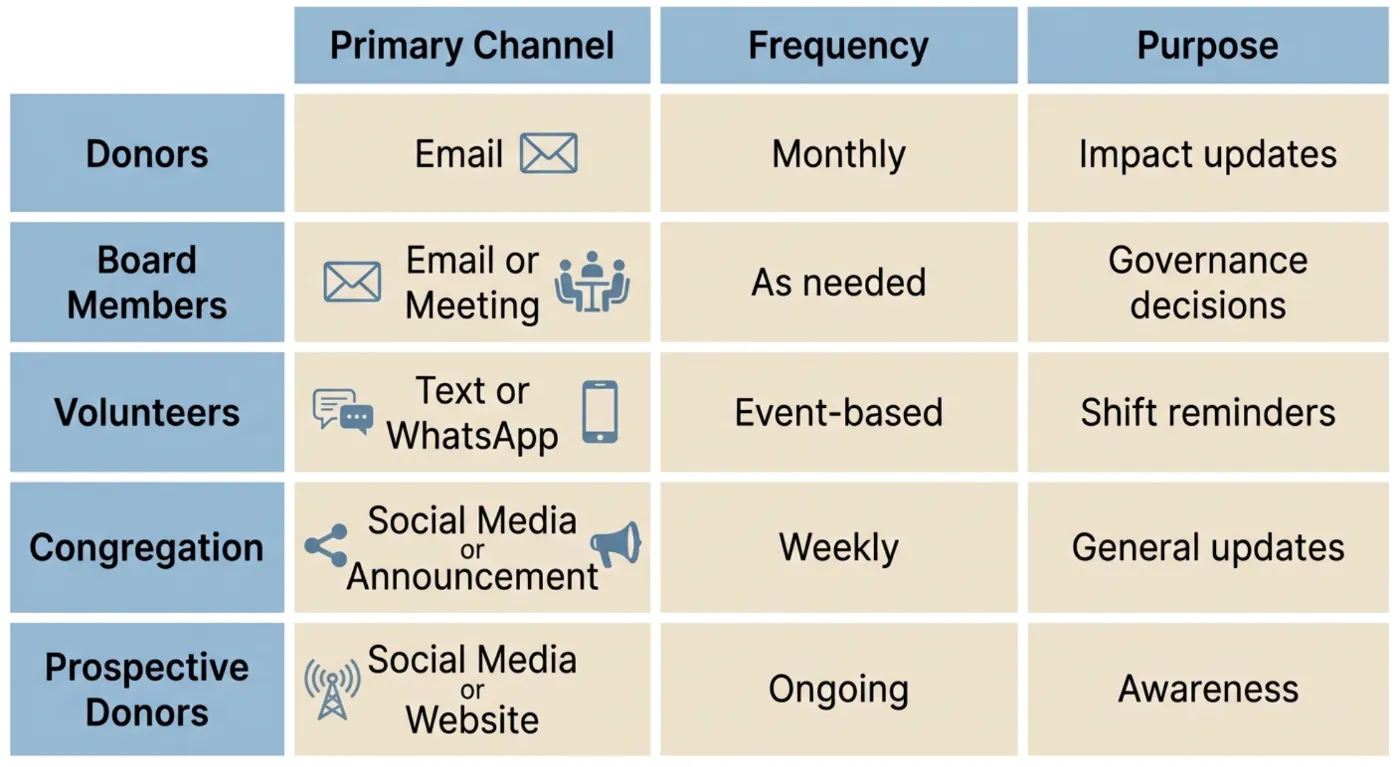
Donors, who need updates on how their gifts were used and timely reminders during giving seasons. Board members, who need governance updates and decisions that require their input, not a flood of every operational detail. Volunteers, who need clear asks with specific dates and roles, not vague calls for help. The congregation broadly, who need to know what is happening at the masjid whether or not they give money. And first-time visitors or prospective donors, who need an easy way to understand what your masjid does before you ask them for anything.
Each of these groups needs different information at a different frequency. Treating them as one undifferentiated list, blasting the same email to everyone, is the single biggest reason communications plans fail before they start.
Map Channels to Each Audience
Once your audiences are defined, matching channels becomes straightforward. Email works well for donors and board members who expect detail and are willing to read a few paragraphs. Social media works for the broader congregation and for reaching people who do not yet give but might attend an event. Announcements before or after Jummah reach people who are physically present but may never open an email. Text messages or WhatsApp groups work for time-sensitive asks, a volunteer shift filling up or a last-minute campaign push. An annual report or year-in-review document works for donors and funders who want the full picture once a year rather than a stream of updates.
CCS Fundraising’s research on donor communication preferences points out that different generations of donors respond to different channels and levels of personalization, and with an estimated $84.4 trillion in assets expected to shift to younger generations by 2045, a masjid that only communicates through one channel is narrowing its own donor base without realizing it. A plan does not need every channel running constantly. It needs the right channel matched to the right audience for the right kind of message.
Build the Calendar Around Your Actual Year
A generic monthly content calendar does not fit how a masjid actually operates. Your communication needs spike hard around Ramadan and Eid, pick up again around Giving Tuesday and year-end giving, and go quiet during summer months when attendance and donor attention both drop. Building the calendar around this real rhythm, instead of forcing a steady weekly cadence all year, keeps the plan realistic for a small team to actually follow.
A simple version of this calendar lists, month by month, which audience gets contacted, through which channel, and for what purpose. Ramadan might mean daily social posts and a weekly donor email. A quiet month in the summer might mean a single newsletter and nothing more. Writing this down ahead of time means nobody is deciding what to send at the last minute during your busiest weeks.
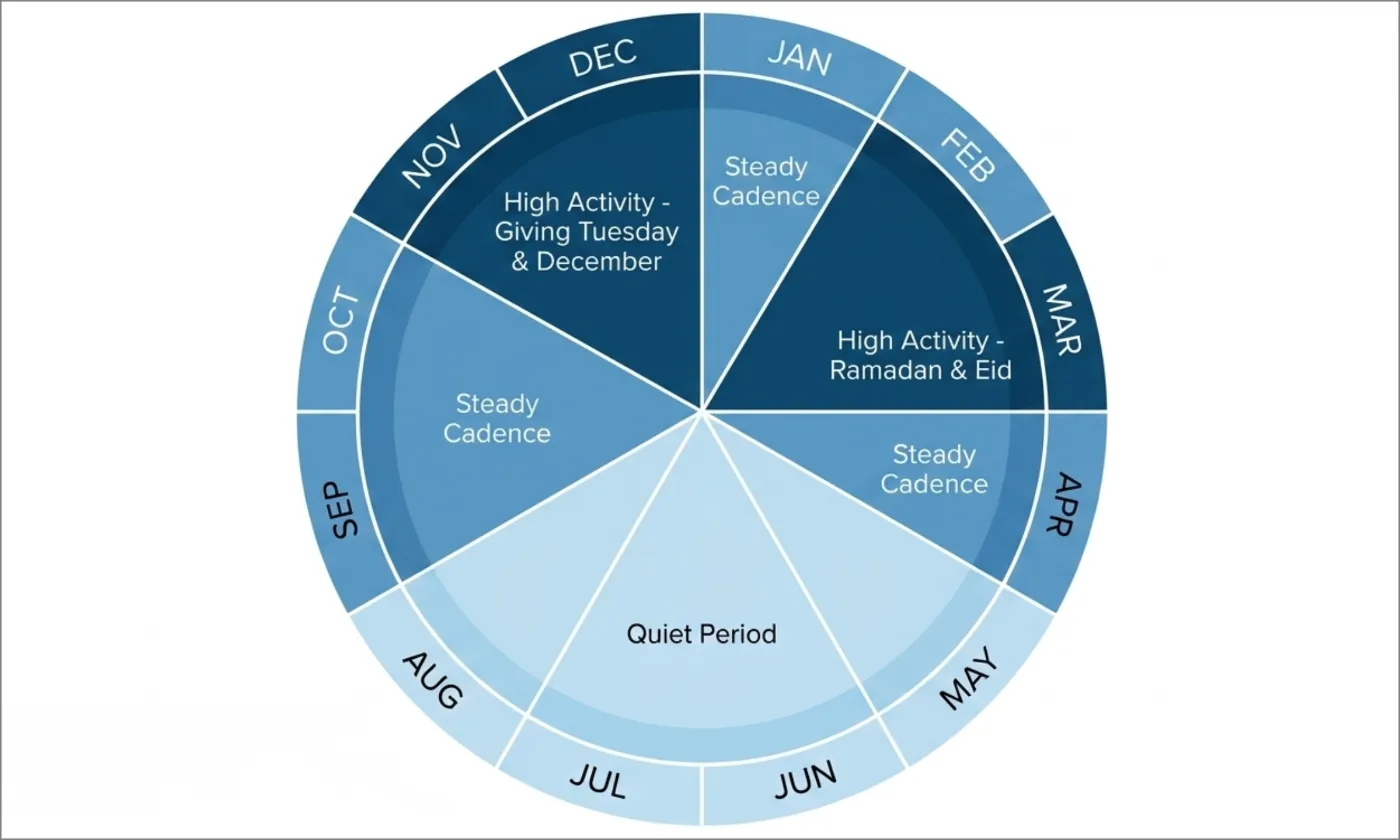
Ramadan and Eid dates shift earlier each year on the Gregorian calendar. Adjust this wheel’s high-activity segment to match the current year’s dates.
Assign Ownership Before You Need It
Most communications plans fail not because the plan itself is wrong, but because nobody specifically owns it. If sending the Jummah announcement, posting on social media and drafting the donor email all technically belong to “whoever has time,” none of them reliably happen. A workable plan names one person responsible for each channel, even if that person is a volunteer with limited hours, and sets a simple backup so a single person’s absence does not mean a missed communication during Ramadan or a giving deadline.
This does not need to be complicated. A single shared document listing each channel, who owns it and how often it goes out is often enough for a masjid with a small staff and a handful of active volunteers.
Plan for the Message You Hope You Never Send
Every communications plan should include a short section nobody wants to think about: what happens if something goes wrong. A safety incident, a leadership change, a financial concern raised publicly, or any situation that requires the masjid to communicate quickly and accurately rather than reactively. Deciding in advance who is authorized to speak on the masjid’s behalf, which channel gets used first and what tone the message should strike takes the pressure off in the moment it actually matters. The National Council of Nonprofits frames this kind of advance planning as part of what keeps an organization’s communications trustworthy during periods of real uncertainty, not just during routine updates.
Review the Plan Twice a Year
A nonprofit communications plan is not a document you write once and file away. Board transitions, new programs, a shift in donor demographics or simply what worked and what fell flat over the past six months all change what the plan should look like going forward. Reviewing it twice a year, once before Ramadan planning begins and once after year-end giving wraps up, keeps it aligned with what the masjid is actually doing rather than what seemed reasonable a year earlier.
How This Fits With Branding and Social Media
A nonprofit communications plan is not the same thing as branding or a social media strategy, though all three work together. Branding governs how your masjid looks and sounds across every piece of communication. Social media strategy governs one specific channel within a broader communication strategy. The communications plan sits above both, deciding which audiences get reached through which channels and how often, so that branding and social media execution have a clear structure to follow rather than operating on their own separate schedules.
Frequently Asked Questions
Q1. How long should a masjid’s communications plan be?
For most masjids, one to two pages is enough. A list of audiences, the channel matched to each, an annual calendar and a named owner for each channel covers what actually matters.
Q2. Who should be responsible for writing the communications plan?
Usually a board member or senior staff member with input from whoever manages social media, email and donor communications day to day, since they know what is realistic to maintain.
Q3. How is a communications plan different from a fundraising campaign plan?
A fundraising campaign plan is built around a single goal and a defined timeline, like a capital campaign or a Ramadan appeal. A communications plan is ongoing and covers every regular touchpoint the masjid has with donors, board members and the congregation, not just fundraising moments.
Q4. Does a small masjid really need a formal plan, or is that overkill?
A small masjid needs this more, not less, since there is no communications staff to absorb the confusion when nobody knows who is supposed to send what. A one-page plan is proportionate and realistic for a small team.
Q5. How often should donors hear from a masjid outside of giving campaigns?
Most nonprofit communication guidance suggests donors hear from an organization at least quarterly outside of active campaigns, often through a brief update on how their previous gifts were used.
Q6. Should the board see every piece of communication before it goes out?
No. Routine updates and social posts should move through an approved channel owner without board review. Reserve board sign-off for major announcements, crisis communication and anything tied to governance changes.
Q7. What is the biggest reason communications plans fail in practice?
Lack of ownership. A plan that lists channels and audiences but does not name who is responsible for each one tends to collapse back into ad hoc communication within a few months.
Q8. Should the communications plan include board members as an audience?
Yes. Board members need governance-level updates distinct from what donors or the congregation receive, and treating them as a separate audience with their own cadence avoids either overwhelming them with operational detail or leaving them uninformed on decisions that need their input.