

Nonprofit fundraising strategies usually get written for the planning stage, before a campaign launches. This piece is for the stage nobody writes about: you already followed a plan, your fall campaign is live and the numbers are coming in lower than you expected. If you built your fall campaign using our 90-day fall fundraising plan, this is the companion piece for when week four or five shows a gap between what you hoped for and what actually landed in the account.
This is not another list of fall fundraising ideas. It is a set of nonprofit fundraising strategies built for mid-campaign use. Each of the seven steps below assumes a campaign is already running and gives an executive director, board treasurer or Imam a specific thing to check and fix, in an order that matches how these problems actually show up mid-campaign.
When Your Fall Campaign Needs a Mid-Course Fix
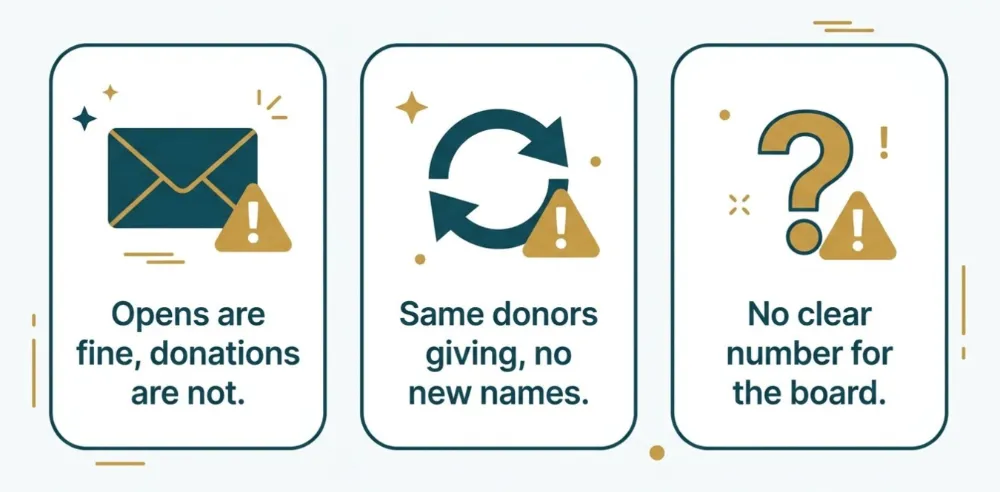
Most small nonprofit teams do not have the bandwidth to run A/B tests or hire a development director partway through October. What you have is a Tuesday afternoon and a decision to make about what to try next before the campaign closes. The signals that it is time for a fix, not a full restart, usually show up the same way: email open rates are fine but donations are not following, the same handful of donors are giving again while new names are not appearing, or a board member asks how the campaign is going and nobody has a clear number to give them.
If any of that sounds familiar, the problem is rarely the campaign concept itself. It is almost always one of seven specific, fixable gaps, and the right response is diagnosis, not a whole new plan.
7 Nonprofit Fundraising Strategies to Raise More During a Slow Fall Campaign
1. Check whether your ask is specific enough
A vague ask like “support our mission this fall” gives a donor nothing to picture. Pull up your current campaign email or Jummah announcement script and check if it names a dollar amount, a specific need and what that gift actually pays for. If it does not, rewrite the next send before doing anything else on this list. This single fix moves more donors than any new channel or tactic.
2. Separate your warm list from your cold list
Sending the identical email to a donor who gave three times this year and someone who has never given creates two problems at once. Warm donors feel like a number, and cold prospects get an ask that assumes trust that is not there yet. Split your list into at minimum two segments and write one line in each version that only makes sense for that group, even if the rest of the email stays the same.
3. Get a board member or the Imam to make five personal asks
Most fall campaigns run entirely through email and social media, which is exactly why they plateau. A phone call or a five-minute conversation after Jummah from someone the donor already trusts converts at a different rate than an email ever will. Ask one board member to personally reach out to five lapsed or major donors this week, not the whole list, just five.
4. Check your donation page on an actual phone
Not a description of what it should look like, an actual test on a phone, mid-campaign, this week. A broken or slow-loading donation page silently kills conversions and nobody notices because the traffic still shows up in your analytics. This takes ten minutes and has caught real problems before.
5. Add one recurring-gift ask to your next email
If your fall campaign has been entirely one-time-gift asks, add a single line offering a monthly option instead. Recurring donors are dramatically more likely to stay active over time than one-time givers, with monthly donors roughly 9 times more likely to keep giving over three years.
6. Activate a matching gift if you have not already
If a board member or major donor is willing to match gifts up to a set amount, a slow week is exactly when to announce it, not save it for Giving Tuesday. A matching gift gives your next email a real reason to open and a real reason to give today instead of putting it off. About one in three donors say they would give more if their gift were matched.
7. Pull a real number and share it with your board
Vague updates like “the campaign is going okay” do not help anyone make a decision. Pull the actual dollar figure against your goal and share it with your board this week. A specific shortfall number tends to produce specific help, board members offering to make calls or share the campaign, in a way that a general status update never does.
Frequently Asked Questions
Q1. How do we know if our fall fundraising campaign needs a full restart or just a fix?
If your campaign concept is sound and you are getting some response, even a modest one, a fix from the list above is almost always the right move. A full restart is only worth considering if the campaign has produced close to zero response after several weeks despite multiple sends.
Q2. Should a small nonprofit with no development staff try all seven strategies at once?
No. Start with the ask-specificity check and the phone test, since both take under an hour combined and often reveal the actual problem. Add the others one at a time based on what the first two fixes surface.
Q3. How is this different from the 90-day fall fundraising plan?
The 90-day plan is for building a fall campaign before it launches. This guide is for diagnosing and improving one that is already running and underperforming. Use the 90-day plan first, then come back to this piece if results are lagging partway through.
Q4. Does adding a matching gift really change donor behavior mid-campaign?
Yes, in most cases. A matching gift creates urgency and a sense that a donation goes further, which tends to move donors who were on the fence to act now instead of waiting.
Closing Thought
A slow fall campaign is rarely a sign that the whole plan failed. It is usually one or two specific gaps, a vague ask, an untested donation page, a missing personal touch, that are simple to find once you know where to look. These nonprofit fundraising strategies work because they target those specific gaps first, before assuming the entire campaign needs to be rebuilt.