
A nonprofit reserve fund policy sets the rules for how much your mosque keeps in savings, when the board can dip into it, and who has to sign off before it happens. Without one, a reserve fund tends to drift into becoming a second checking account. Money goes in after a strong Ramadan campaign, then quietly comes out for a roof repair or a shortfall in operating costs, and within a year or two there is no real reserve left, just a fund that used to be one.
The problem gets more specific for a masjid than it does for a typical nonprofit. Most reserve fund guidance assumes you will park the money in an interest-bearing savings account or a low-risk money market fund. For a mosque, that default option runs straight into a riba problem, and almost none of the standard nonprofit finance guides mention it.
What Mosque Boards Commonly Get Wrong
A handful of mistakes show up again and again in masjid reserve funds, usually because nobody wrote a policy down in the first place.
- Counting restricted funds, like zakat or building fund donations, as part of the general reserve.
- Treating the reserve as a second checking account instead of a fund with defined access rules.
- Using the operating reserve to cover a predictable capital project instead of budgeting for it separately.
- Keeping reserve funds in a default interest-bearing account without considering the halal placement question.
- Drawing from the reserve without a written replenishment plan, so the fund never gets rebuilt.
- Leaving the withdrawal decision to whoever happens to be treasurer at the time, with no defined approval threshold.
- Never recalculating the target amount as the mosque’s budget and programs grow.
- Holding a reserve balance in practice but having no written policy that actually governs it.
The rest of this guide works through how to avoid each of these.
Why a Nonprofit Reserve Fund Policy Needs Rules, Not Just Good Intentions
Nonprofits without a formal reserve fund policy generally have one of two problems. Either they never build a reserve at all, spending every dollar raised as it comes in, or they build one and then quietly deplete it because nobody defined what counts as an emergency versus what counts as convenient. A written policy fixes both by setting a target amount, usually expressed as a number of months of operating expenses, and by naming exactly who can authorize a withdrawal and under what circumstances.
The Association of Fundraising Professionals points out that a meaningful share of nonprofits operate without any reserve fund separate from their regular operating cash, which means a single bad quarter, a delayed grant payment or an unexpected repair can put programs at risk. For a masjid, that risk shows up as delayed salary payments to the imam, a paused community program, or a scramble for emergency fundraising during a season the mosque was not planning to fundraise in.
A common starting range is three to six months of operating expenses, though a masjid running a school, a food pantry or a shelter alongside regular operations may want to lean toward the higher end, since those programs carry obligations that cannot simply pause. The actual right number depends on the mosque’s revenue volatility, how much of its funding is restricted, payroll and debt commitments, and how predictable its fundraising cycle is, so the target should come from the board’s own analysis rather than a borrowed rule of thumb. The Nonprofit Operating Reserves Initiative publishes a widely used toolkit that most boards adapt rather than build from scratch, and it is a reasonable starting point before customizing for a masjid’s specific structure.
How to Calculate the Reserve Target
A target expressed only as “three to six months of expenses” leaves out the part a treasurer actually needs, which expenses to count. A practical formula is straightforward: average monthly core unrestricted operating expenses multiplied by the target number of months.
Core operating expenses generally include payroll, utilities, insurance and routine facility maintenance, the costs that continue whether or not a specific program is running. Boards should generally exclude expenses that are fully and reliably funded by restricted sources, while considering any portion the mosque would still have to cover from unrestricted cash if that restricted funding arrived late or fell short, since a restricted program can still create real cash-flow pressure in the meantime. One-time capital expenditures are excluded as well, since those belong in the separate capital reserve discussed above rather than the operating reserve. Debt service is usually included if the mosque carries a mortgage or loan, since missing a payment has real consequences regardless of program activity. Depreciation, being a non-cash accounting entry rather than an actual monthly outflow, is generally left out of the calculation.
A masjid with $40,000 in average monthly core operating expenses working toward a four month target would set a nonprofit reserve fund policy goal of $160,000. Recalculating this figure once a year, alongside the annual budget process, keeps the target realistic as staffing, facility costs, or program scope change.
Which Funds Actually Count as Reserve
Before a board sets a target amount, it needs to answer a question that trips up a lot of masjid treasurers: which dollars in the bank are actually eligible to sit in reserve. A reserve fund should be built from unrestricted donations, the general sadaqah and operating gifts that carry no donor-attached purpose. According to most Islamic finance and zakat administration guidance, zakat funds do not belong in a general operating reserve, since zakat is generally required to reach eligible recipients within a defined timeframe rather than sit indefinitely as an organizational cushion, though the specific rules and timing can vary by scholarly opinion and the fiqh council a mosque follows. Boards should treat this as a starting principle to confirm with their own scholar or Islamic finance advisor, not a settled ruling that applies identically everywhere. The same caution applies to sadaqah earmarked for a specific program, building fund donations collected for a construction project and school-specific tuition assistance funds, all of which carry donor-defined purposes that a general reserve should not absorb without separate written permission. Mixing these into a single reserve number overstates what the mosque can actually draw on in an emergency, and it creates a real governance problem if a donor ever asks why restricted funds were used to cover an unrelated shortfall.
A nonprofit reserve fund policy should state this explicitly: the reserve is funded from unrestricted net assets only, and restricted gifts stay separate and get used strictly for the purpose the donor specified, unless the donor has given written permission for broader use.
Operating Reserve or Capital Reserve, Not the Same Bucket
A second distinction generic guidance rarely draws out clearly enough for a masjid. An operating reserve covers short-term disruptions, a missed grant payment, a slow fundraising quarter, an unexpected legal bill. A capital reserve is a separate pool set aside for large, predictable future expenses tied to the building itself, a roof replacement, HVAC system or parking lot resurfacing that the board can see coming years in advance. Treating these as one combined number tends to create the worst of both outcomes. The mosque either drains its emergency cushion on a scheduled building project, or delays a needed repair because touching the fund feels like touching the emergency reserve. A masjid with meaningful facility assets is usually better served keeping these as two named funds within the same policy, each with its own target and its own rules for use, even if both sit in the same bank relationship for simplicity. This distinction covers planned, predictable capital expenditures, not sudden ones. An unexpected facility failure, a burst pipe or storm damage that cannot wait for the next budget cycle, can still qualify as a legitimate emergency draw against the operating reserve if the policy allows it, since the defining feature of a capital reserve is that the expense was foreseeable, not simply that it involves the building.
The Halal Placement Problem Nobody’s Guide Covers
Once a mosque has decided on a target reserve amount, the next question is where that money actually sits. Generic nonprofit guidance points toward a high-yield savings account or a low-risk money market fund, both of which typically generate returns through interest. For a masjid operating under Islamic finance principles, interest income is not a neutral detail, it is something the organization generally needs to avoid receiving and, when unavoidable, needs a documented process for handling rather than simply keeping.
A workable reserve fund policy for a masjid should name the acceptable placement options explicitly rather than leaving it to whoever happens to be treasurer that year. Common approaches include a non-interest-bearing checking or demand deposit account for the more liquid portion of the reserve, and Sharia-compliant money market or short-term instruments for the portion that can sit longer without being touched. Some mosques work with an Islamic financial institution or a conventional bank’s Islamic banking window specifically to avoid this issue altogether.
This is also an area where a written policy should point to a person rather than a rule. Questions like which specific Islamic institutions the mosque will work with, what Sharia standard the board is relying on, and what happens if interest gets credited to an account by accident are not questions a generic template can answer correctly for every masjid, since practice varies by scholarly opinion and by which Islamic finance body the community follows. The policy should simply name a qualified Islamic finance advisor, a local scholar, or the mosque’s existing religious authority as the party responsible for reviewing placement decisions and for determining, according to that advisor’s guidance and any applicable accounting requirements, how accidental interest income should be handled, rather than the article or the policy itself prescribing a specific fiqh answer.
What the Policy Should Actually Include
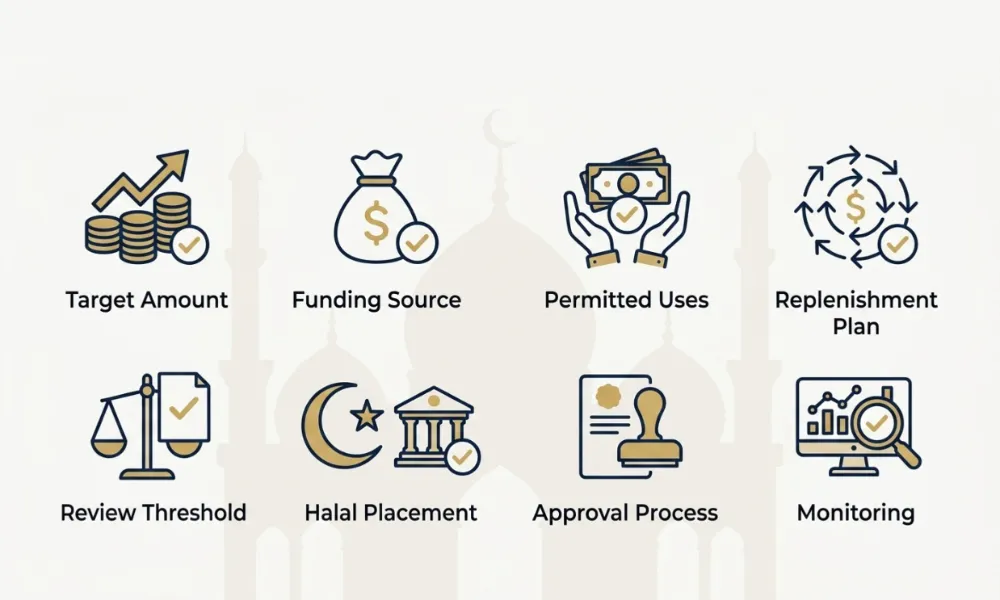
A nonprofit reserve fund policy for a masjid board needs a handful of components to actually function day to day, not just look complete on paper.
- Target amount. A dollar figure or a range of months of operating expenses, reviewed annually as the budget changes.
- Eligible funding source. Unrestricted donations only, with restricted gifts like zakat, building funds and program-specific sadaqah explicitly excluded from the reserve calculation.
- Permitted uses. What counts as an emergency draw, such as a major revenue shortfall or an unplanned facility repair, versus what does not, like routine budget gaps that should be solved through fundraising instead.
- Replenishment plan. Any draw against the reserve should come with a stated restoration period appropriate to the size of the draw and the mosque’s expected cash flow, commonly around twelve months as a starting example, so the board has a deadline for rebuilding the fund rather than an open-ended intention to get to it eventually.
- Target and review threshold. Rather than a hard ceiling, the policy should set a target reserve level and require the board to document a specific purpose whenever the balance runs materially above that target, since donors and watchdog groups can grow uneasy if a mosque appears to be sitting on years of expenses instead of putting funds toward programs.
- Halal placement rules. The acceptable vehicles for holding reserve funds, and who reviews and approves them, as described above.
- Approval process. Who can authorize a draw and at what dollar threshold. This looks different depending on how the masjid is structured. A mosque with paid staff may let the executive director approve smaller draws independently, with anything larger going to the board. A volunteer-run masjid without an executive director typically routes this through the treasurer and finance committee instead, with the full board voting on any draw above a set amount.
- Monitoring. The finance committee or treasurer reports on reserve fund status at a set interval, usually quarterly, so the board is never surprised by how much is actually left.
A short sample clause for a nonprofit reserve fund policy’s permitted-uses section might read: “Reserve funds may be drawn only for expenses that threaten the continuity of core operations or facility safety. Draws up to [$X] may be authorized by the [executive director / treasurer, per the mosque’s structure], with anything above that amount requiring a majority vote of the board. Every draw must include a written replenishment plan restoring the fund within a board-approved timeframe.” Boards can adapt language like this directly, filling in the dollar threshold and the appropriate approver for their own governance structure, rather than starting from a blank page.
Tying It to the Rest of the Board Packet
A reserve fund policy does not sit in isolation. It works alongside a masjid’s other financial governance documents, and boards that already have a gift acceptance policy and a conflict of interest policy in place usually find the reserve policy easier to write, since the finance committee’s roles and disclosure habits are already established. It also connects directly to a masjid’s record retention policy, since every reserve fund draw and replenishment should be documented and retained according to the organization’s record retention policy and applicable legal requirements.
Bring the draft nonprofit reserve fund policy to the board as a formal agenda item rather than an informal conversation, get it adopted by vote, and record that adoption in the minutes. Revisit the target amount and placement rules once a year, since a mosque running a capital campaign or opening a new program will often need to adjust both.
FAQs
Q1. How much should a mosque keep in reserve?
Three to six months of core operating expenses is a common starting range, but the appropriate target depends on the mosque’s revenue volatility, restricted funding, payroll and debt commitments, facility obligations, and fundraising cycle.
Q2. Can nonprofits have reserve funds?
Yes. Nonprofits are permitted to hold reasonable reserves, and most funders and watchdog groups view a documented reserve policy as a sign of financial stability rather than a red flag, as long as the reserve amount is reasonable relative to the organization’s budget.
Q3. Where can a mosque keep reserve funds without earning interest?
Common options include a non-interest-bearing checking account for the liquid portion and Sharia-compliant money market instruments, often structured around murabaha contracts, for funds that can sit longer, sometimes through an Islamic financial institution or an Islamic banking window at a conventional bank.
Q4. Who should approve using reserve funds?
Most policies allow the executive director to authorize small draws independently up to a set dollar threshold, with anything larger requiring a formal board vote, and every use documented in the meeting minutes regardless of size. Volunteer-run masjids without an executive director typically route this through the treasurer and finance committee instead.
Q5. Can zakat or building fund donations count toward the reserve?
Generally, no. A general operating reserve should be funded from unrestricted funds. Zakat must be handled according to the mosque’s applicable Sharia guidance, while building funds and other donor-restricted gifts should remain dedicated to their stated purposes unless a properly documented and permitted change is made.
Q6. What happens if a reserve fund is used?
A sound policy requires any draw to include a written replenishment plan within a board-approved period appropriate to the size of the draw and the mosque’s cash flow, often around twelve months as a starting example, so the reserve gets rebuilt rather than quietly staying depleted.