
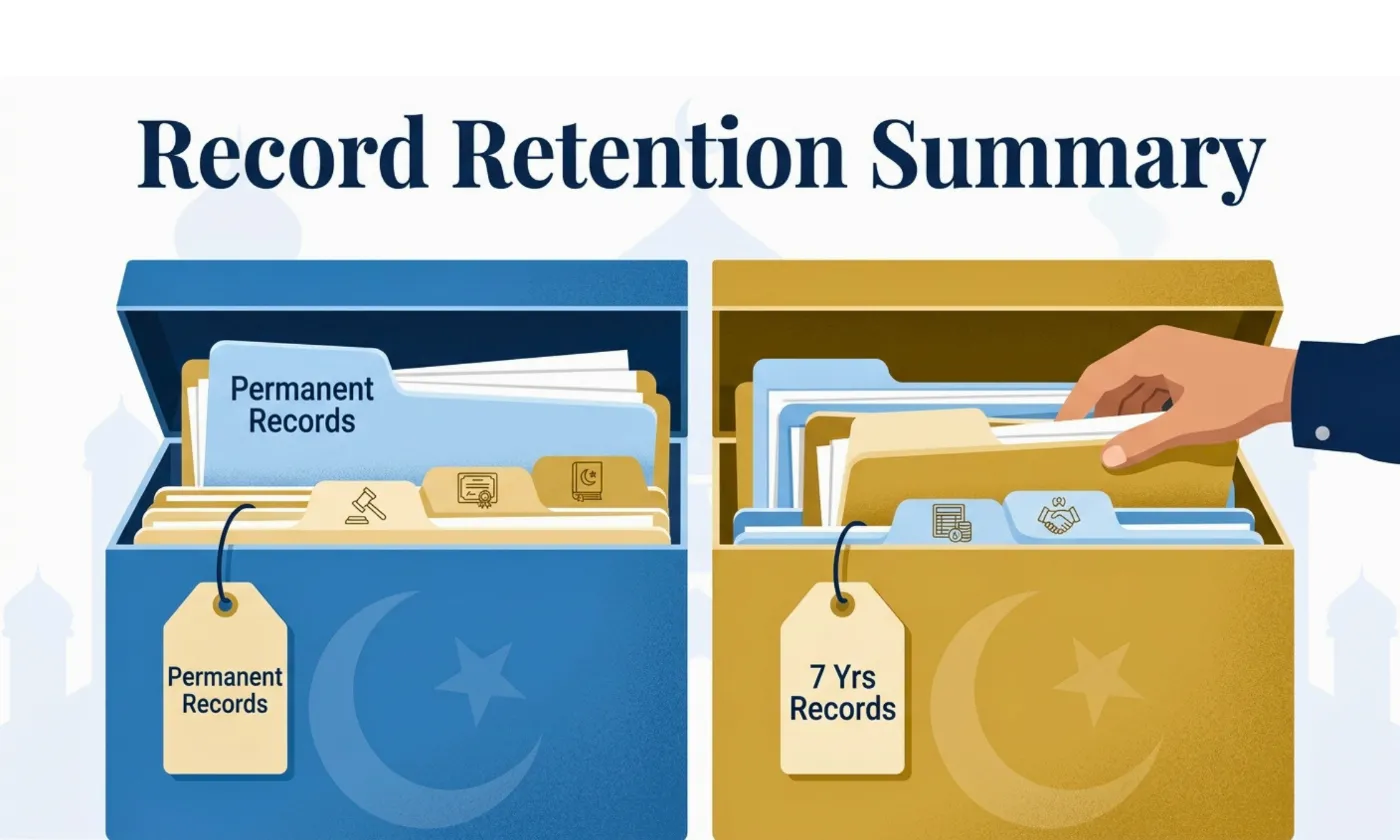
Document retention policy is the foundation of good nonprofit governance, and it does not need to be complicated to be effective. The core of it is a simple table: what kind of record, how long you keep it, and who is responsible for storing or destroying it. The IRS asks about this directly on Form 990, which requires every filing nonprofit to state whether it has adopted a written retention policy, so a mosque or Islamic center without one is flagging a gap the moment that form gets filed.
Most nonprofit retention policies group records into three buckets. Permanent records include articles of incorporation, bylaws, board meeting minutes and any document establishing tax-exempt status, none of which should ever be destroyed. Long-term records, typically kept for seven years, cover financial statements, tax filings, donor acknowledgment letters and grant agreements, largely because that window matches how far back the IRS can generally look during an audit. Short-term records, usually kept for two to three years, include routine correspondence, expired vendor contracts and outdated marketing material.
How Long Should a Nonprofit Keep Financial Statements?
Financial statements, tax returns and audit reports should generally be kept for at least seven years, and many nonprofits choose to keep year-end financial statements permanently since they document the organization’s full financial history. Records tied to a specific grant should be kept for at least seven years past the grant’s closeout date, since funders can request documentation well after a program ends.
IRS Requirements for Nonprofit Document Retention
The IRS does not hand nonprofits a single official retention schedule. What it does require, through Form 990, is a written policy that staff, board members and volunteers actually follow, along with permanent retention of anything tied to your original tax-exempt determination letter. The Sarbanes-Oxley Act adds a separate, sharper requirement on top of that: destroying documents related to a federal investigation or official proceeding, even accidentally, can carry criminal penalties, so any retention policy needs a clear rule for pausing destruction the moment litigation or an investigation is even a possibility.
State law adds another layer most nonprofits miss. Charitable solicitation and employment record requirements vary by state, so a mosque operating in more than one state, or receiving donations from donors across state lines, should confirm the longer of the federal and state requirement for each record type rather than assuming the federal minimum covers everything.
What Nonprofit Document Types Require Special Retention Guidelines?
Beyond the standard financial and governance records, mosques and Muslim nonprofits generally handle a few record types that most generic retention templates never mention. Zakat and sadaqah fund records need their own retention line, separate from general donations, since donors and auditors may ask to verify that restricted funds were used within their intended purpose.
Records from nikah services, funeral or janazah arrangements and community counseling sessions carry a higher privacy expectation than routine correspondence and should be retained under stricter access controls, not just a standard retention timeline. Halal certification documentation for a food pantry or community kitchen program should be kept for the life of the certification plus a few years afterward, in case a past claim is ever questioned.
Step-by-Step Guide to Implementing a Document Retention Policy
- Inventory what you already have. List every record type your organization actually generates, from board minutes to Ramadan campaign donor lists, before writing a single retention rule.
- Assign a retention period to each category. Use the permanent, seven-year and short-term buckets above as a starting point, then check state-specific rules for anything involving employment or charitable solicitation records.
- Name a records owner. One board member or staff member should be responsible for the policy’s enforcement, not “whoever gets to it.”
- Put it in writing and adopt it formally. A policy the board never formally adopted carries far less weight if it is ever questioned during an audit or investigation.
- Review it every year or two. Board turnover and new programs both tend to create new record types the original policy never anticipated.
Where to Find a Nonprofit Document Retention Policy Template
The National Council of Nonprofits and the Nonprofit Risk Management Center both publish general sample language nonprofits can adapt, though neither offers a one-size-fits-all option since retention needs vary by state and by the type of programs an organization runs. A generic template is a reasonable starting point, but a mosque board should still walk through it line by line rather than adopting it word for word, since most templates say nothing about Zakat fund documentation or faith-based program records.
Frequently Asked Questions
Q1. What is a nonprofit document retention policy?
It is a written set of rules that spells out what records an organization keeps, for how long and who is responsible for storing or destroying them. The IRS asks about this directly on Form 990.
Q2. How long should a nonprofit keep financial documents legally?
Most financial records, including tax filings and audited financial statements, should be kept at least seven years, with many organizations choosing to keep year-end financial statements permanently.
Q3. Is this kind of policy legally required for nonprofits?
There is no single federal law mandating one, but the IRS asks about it on Form 990, and having a written policy is considered a governance best practice that funders and auditors expect to see.
Q4. What happens if a nonprofit does not have a retention policy?
Without one, a nonprofit risks destroying records it later needs for an audit, a grant renewal or a legal matter, and it also risks accidentally violating retention laws it did not know applied. A missing policy is also a flag on Form 990 that donors and watchdog platforms notice.
Q5. Do document retention rules differ by state?
Yes. Charitable solicitation registration records and employment records in particular carry state-specific requirements, so a nonprofit fundraising in more than one state should check each state’s rules rather than relying on federal minimums alone.