
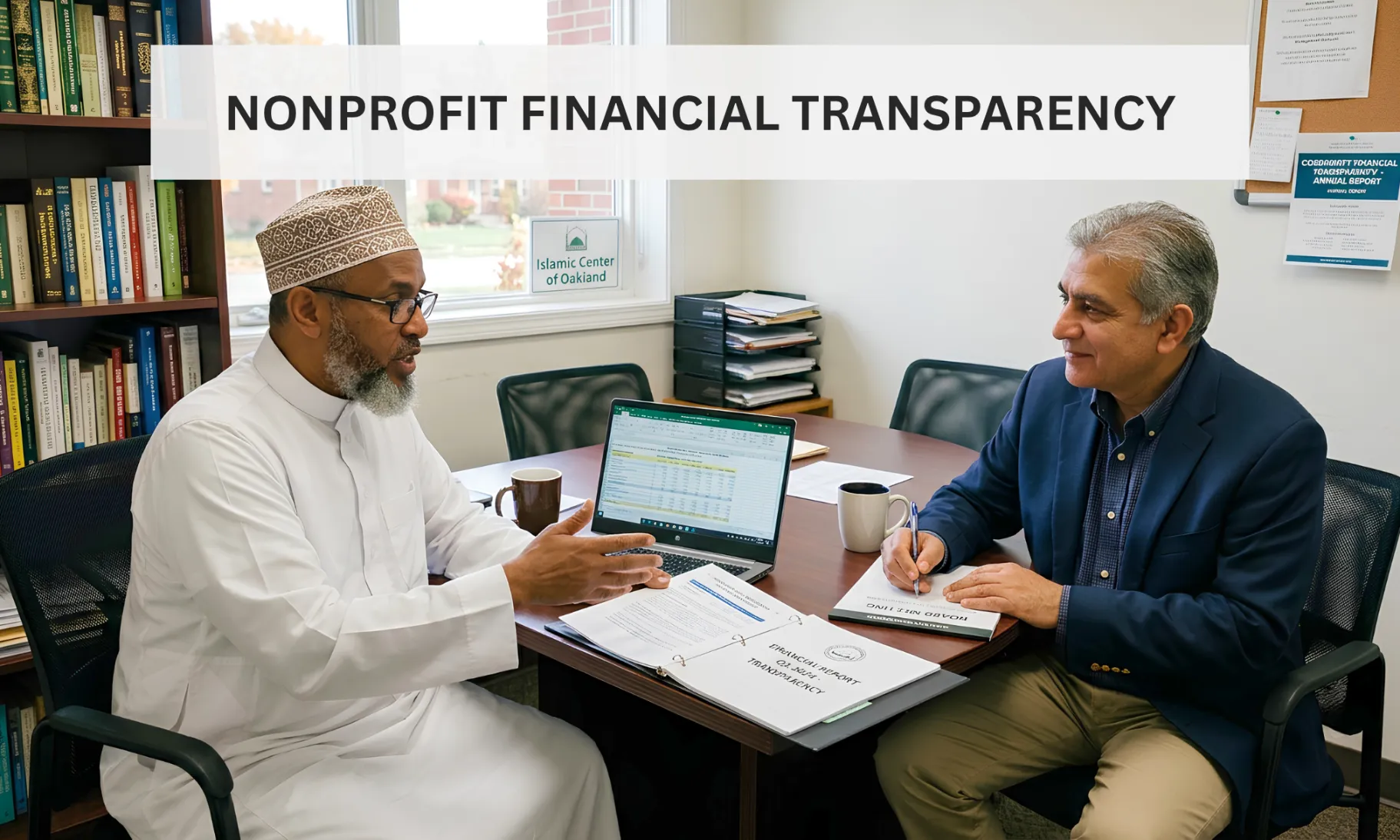
Nonprofit financial transparency is one of those things every mosque board agrees is important and almost none of them actively practice beyond the legal minimum. The Form 990 gets filed, the accountant signs off, and that is usually where it stops. Meanwhile congregants are left wondering where their Ramadan donations actually went, and that quiet uncertainty is exactly what erodes giving over time, long before anyone says anything out loud.
Do 501c3s Have to Disclose Their Financials to the Public?
Yes. Under federal law, a 501c3 organization must make its three most recent Form 990 filings and its original exemption application available for public inspection on request, and most nonprofits now publish these automatically on sites like Candid or ProPublica’s Nonprofit Explorer once filed. This is not optional and it is not a courtesy, it is a legal requirement enforced by the IRS.
What is optional, and where most mosques fall short, is going beyond the bare legal minimum to actually make that information usable for the people giving. A 990 buried in a database that nobody at your mosque points congregants toward is technically compliant and practically invisible.
Why This Matters More for a Mosque Than Most Nonprofits
Diaspora donors in particular tend to carry real skepticism, often shaped by stories of mismanagement at mosques back home or at other Islamic centers in the US. That skepticism does not go away on its own. It gets addressed by a board that proactively shows its work, or it quietly shrinks giving from people who never say why they stopped.
Financial transparency for mosque donors is also a values question, not just a legal one. Sadaqah and zakat carry specific religious weight, and donors reasonably expect more accountability for money given with that intention than they would for a routine retail purchase.
The 33% Rule and Why It Protects Your Public Charity Status
Most mosque boards have never heard of the public support test, sometimes called the 33% rule, but it directly affects donor confidence. To keep public charity status instead of being reclassified as a private foundation, a 501c3 generally needs at least one third of its total support to come from the general public rather than a small handful of large donors, measured over a rolling five year period.
A broad base of small and mid-size donors is not just good for your budget, it is a structural requirement for staying a public charity in the first place, and boards that understand this have one more reason to actively cultivate everyday congregant giving rather than leaning on two or three wealthy families.
6 Nonprofit Financial Transparency Practices for Mosque Boards
1. Publish your Form 990 where people actually look
Link it directly from your website’s donate or about page, not buried three clicks deep. If your mosque is too small to file a full 990, publish your 990-N or annual financial summary instead.
2. Translate the 990 into a plain language breakdown
A tax form is not built for a congregant trying to understand where their money went. A simple one page summary, operations, programs, facility, community services, does more for donor confidence than the raw filing ever will.
3. Show where Ramadan and Zakat funds specifically went
General fund donations and religiously designated funds carry different expectations. A short annual note breaking out how Zakat-eligible funds were distributed answers the question mosque donors are actually asking before they ask it.
4. Get an annual financial review and share the summary
A full audit is expensive for a small mosque, but an independent financial review is far more affordable and still signals that someone outside the board looked at the books. Share the summary findings, not just the fact that a review happened.
5. Name a real person congregants can ask
Put a name and contact method, not just a generic email, on your website for financial questions. Vague accountability reads as no accountability at all.
6. Clarify Corporate Transparency Act confusion before it spreads as a rumor
Some congregants have heard about the Corporate Transparency Act and worry it means new personal disclosure requirements for board members. Most 501c3 organizations are exempt from the Act’s beneficial ownership reporting. A short, clear note on your website heading off that confusion prevents an unrelated law from becoming a trust problem for your mosque.
What Happens When Mosques Skip This
A board that only meets the bare legal minimum is not breaking any law, but it is leaving trust on the table. Donors who cannot easily see where their money went do not usually complain, they simply give less next Ramadan, and the board often never learns why. If your mosque has not documented who is responsible for financial communication as part of a broader leadership plan, our guide on nonprofit succession planning for mosque boards covers how to make sure that responsibility does not disappear when a treasurer or board member moves on.
If you are still building out your donor and community strategy more broadly, our guide on nonprofit marketing strategies for Muslim nonprofits walks through how transparency, trust and fundraising connect.
Common Questions About Financial Transparency
Q1. Do nonprofits have to make their financials public?
Yes. The IRS requires 501c3 organizations to make their most recent three Form 990 filings and exemption application available on request, and most are also searchable through public databases like Candid or ProPublica.
Q2. What is the 33% rule for nonprofits?
It is the public support test, an IRS requirement that at least one third of a public charity’s support come from the general public rather than a small number of large donors, measured over a five year period.
Q3. Does a mosque have to share its budget with the congregation?
There is no legal requirement to share an internal budget the way there is for the Form 990, but the Council of Nonprofits notes that voluntary transparency beyond the legal minimum is one of the strongest ways nonprofits build public trust.
Q4. Is my mosque affected by the Corporate Transparency Act?
Most 501c3 tax-exempt organizations are exempt from the Act’s beneficial ownership reporting requirements, though boards with any uncertainty about their specific structure should confirm with a nonprofit attorney or accountant.
Nonprofit financial transparency is not about proving your mosque has nothing to hide. It is about making it easy for donors to see exactly where their trust is going, so they keep giving it.