
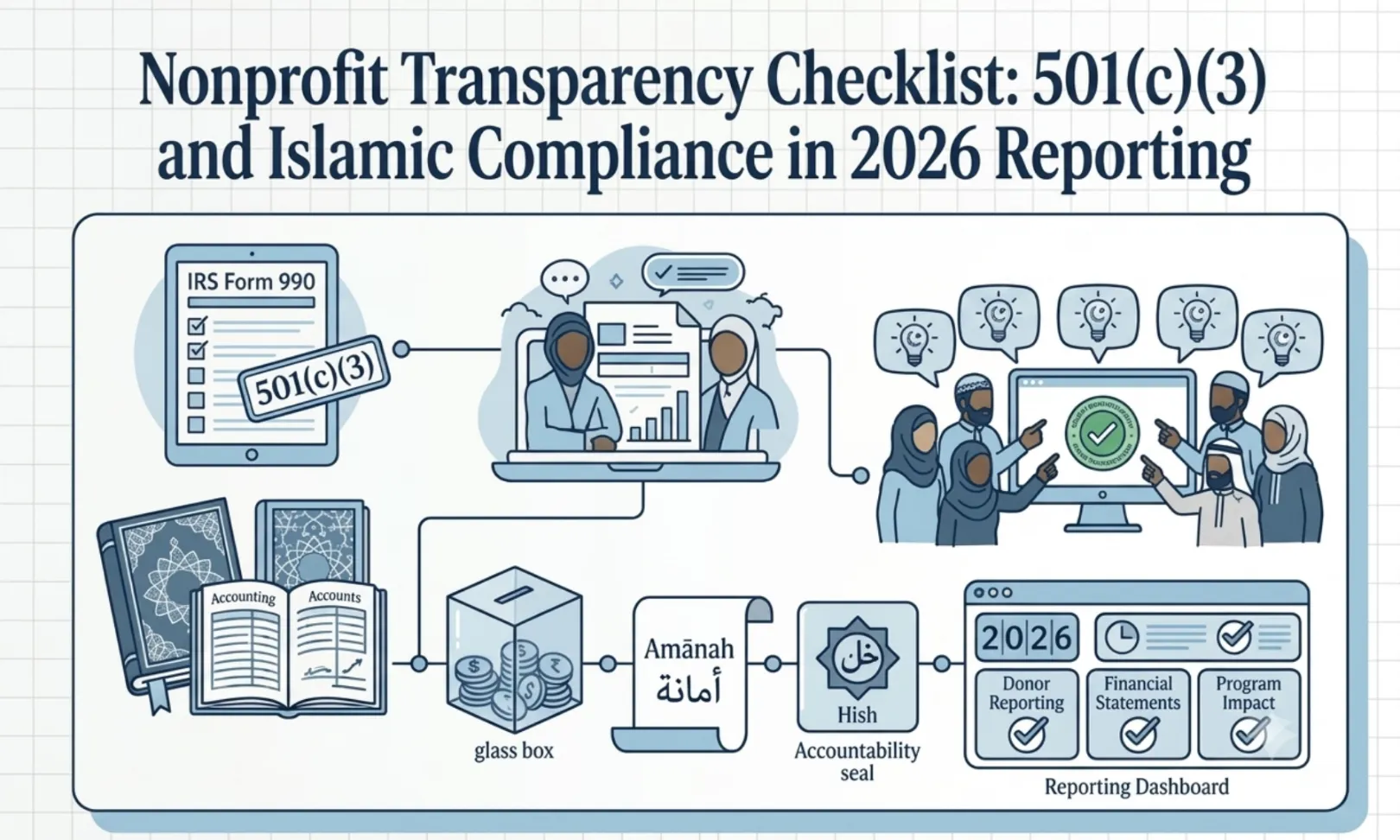
Donors do not give blindly. Before a Muslim nonprofit sees a recurring gift, a zakat transfer, or a year-end donation, most donors quietly check whether the organization can be trusted with their money. That check usually comes down to one thing: nonprofit transparency.
For US-based Muslim nonprofits, transparency is not a single requirement. It sits on two tracks at once. There is the federal layer, built around IRS rules for 501(c)(3) organizations. And there is the Islamic layer, built around how zakat, sadaqah, and waqf funds are handled, disclosed, and reported to donors who care about more than a tax deduction. A nonprofit that only satisfies one of these tracks is only half transparent in the eyes of its core donor base.
Related article: Donor Stewardship After Eid
This checklist breaks down both layers, shows where they overlap and gives you a practical framework for nonprofit transparency to apply before your 2026 annual reporting cycle and before Q4 campaign season begins.
Why Nonprofit Transparency Matters More Than Ever in 2026
Donor scrutiny of nonprofits has grown steadily, and Muslim nonprofits face an added layer of it. Some of that comes from a history of certain Islamic charities facing federal scrutiny in the years after 9/11, which left many Muslim donors more cautious by default. Some of it comes from broader donor behavior. Candid’s research on its Seal of Transparency program found that nonprofits sharing detailed financial and governance information received significantly more in contributions than those that did not.
The practical takeaway is simple. Nonprofit financial transparency is not a compliance checkbox you clear once a year. It is something donors actively look for before they give, and increasingly, before they give again.
The Two Compliance Layers Every Muslim Nonprofit Must Meet
Layer One: IRS 501(c)(3) Compliance
This is the baseline every US nonprofit must meet regardless of faith orientation. It centers on 501c3 annual report requirements set by the IRS. According to the IRS’s annual filing requirements, nonprofit compliance requirements at the federal level include:
- Filing the correct annual return (Form 990, 990-EZ, or 990-N, depending on gross receipts)
- Making the three most recent Form 990 filings publicly available on request
- Maintaining accurate records of board governance, executive compensation, and program versus administrative spending
- Avoiding private inurement or excess benefit transactions
- Filing state-level charitable solicitation registrations in every state where you actively fundraise
None of this is unique to Islamic nonprofits. But it is the foundation. Donors and watchdog platforms check this layer first, and a lapse here (a missed 990, a revoked exemption) undermines everything else you communicate about your mission.
Layer Two: Islamic Financial Accountability
This is where Muslim nonprofits carry additional responsibility that donors specifically watch for:
- Zakat fund segregation. Zakat must be tracked and disbursed separately from sadaqah and general operating funds, since zakat has specific eligible recipient categories under Islamic law.
- Sadaqah and waqf reporting. Donors increasingly ask how flexible giving (sadaqah) differs from restricted or endowment giving (waqf), and expect that distinction to show up in reporting, not just in fundraising copy.
- Shariah governance or advisory oversight. Larger Muslim nonprofits often maintain a scholar or advisory board that reviews fund allocation, particularly for zakat distribution, following the same spirit as international frameworks like AAOIFI’s governance standards used across Islamic financial institutions. Smaller organizations can still document who reviews compliance, even informally.
- Distribution timing disclosure. Because zakat is often collected heavily around Ramadan, donors want to know how quickly and where those funds were distributed, not just that they were collected.
Neither layer replaces the other. A nonprofit can be fully 501(c)(3) compliant and still lose donor trust if it cannot explain how zakat dollars were segregated and distributed. The reverse is also true: strong Islamic accountability practices do not exempt an organization from IRS reporting obligations.
The 2026 Nonprofit Transparency Checklist
Use this nonprofit transparency checklist as a working audit before your next reporting cycle, covering both 501c3 annual report requirements and Islamic fund accountability:
- Most recent Form 990 filed on time and posted publicly (website or Candid profile)
- Board of directors list, with names and roles, visible to the public
- Program-to-administrative expense ratio disclosed in plain language, not just in the 990
- Zakat funds tracked in a separate ledger or fund code from general donations
- Written policy on zakat eligibility criteria and distribution categories
- Annual or semi-annual impact report showing where funds went, by program
- Executive compensation disclosed at the level required by Form 990 Schedule J, where applicable
- State charitable registration current in all active fundraising states
- A dedicated transparency or “financials” page linked from the main navigation, not buried in a footer
- Clear language distinguishing zakat, sadaqah, and waqf on every relevant donation page
If you can check off items one through eight with confidence, your nonprofit compliance requirements foundation is solid. Items nine and ten are where most Muslim nonprofits lose donor trust on nonprofit financial transparency, not because the money is mishandled, but because the reporting is hard to find or not written in terms donors understand.
Form 990 Requirements and Annual Reporting Deadlines
Form 990 requirements depend on your organization’s gross receipts and assets. Most nonprofits with receipts above $50,000 file the full Form 990 or the shorter 990-EZ, while smaller organizations may qualify for the 990-N e-Postcard. The return is due on the 15th day of the fifth month after your fiscal year ends, with a six-month extension available through Form 8868 if needed.
As the National Council of Nonprofits explains, missing this deadline for three consecutive years results in automatic revocation of tax-exempt status, which is one of the fastest ways to destroy donor confidence overnight. If your nonprofit runs on a calendar fiscal year, your 2025 return is due by May 15, 2026, and planning your transparency updates around that same window keeps everything current heading into Q4.
What Donors Actually Look For
When donors research a Muslim nonprofit before giving, they are rarely reading the full Form 990 line by line. They are looking for a handful of signals:
- Can I find the financials in under two minutes on the website
- Does the organization explain, in plain language, how much of my donation reaches programs
- Is there a clear answer for how zakat is handled differently from general donations
- Are leadership and board members named, not anonymous
- Has anything changed recently that I should know about (leadership transitions, program shifts, audit findings)
This is also where nonprofit accountability and transparency intersects with donor retention, and it is a theme worth revisiting every time you plan a new campaign. A donor who can quickly verify how funds are used is far more likely to move from a one-time Ramadan or Eid gift into a recurring monthly commitment, because the friction of “can I trust this organization” has already been resolved.
Building a Public-Facing Transparency Page
Most of the compliance work above already exists somewhere in your organization’s files. The gap is usually presentation. A dedicated transparency page should include:
- A link to or embed of your most recent Form 990
- A one-page visual breakdown of program versus administrative spending
- A short, dated statement on zakat fund handling and distribution timelines
- Board and leadership names with brief bios
- Any third-party seals or ratings you have earned, such as a Candid Seal of Transparency
Keep the language conversational. Donors are not accountants. A sentence like “87 cents of every dollar went directly to program spending in fiscal year 2025” does more work than a linked PDF ever will.
Common Compliance Gaps That Erode Donor Trust
A few patterns show up repeatedly among Muslim nonprofits, even well-intentioned ones:
- Zakat and sadaqah funds tracked in the same general ledger account, making it impossible to report on either accurately
- No public statement distinguishing zakat eligibility from general charitable giving
- Form 990 filed correctly but never linked from the website
- Board list outdated by a year or more
- Impact reporting that talks about mission and stories but never states a dollar figure
None of these are usually intentional. They happen because compliance and communications are handled by different people, or because reporting gets deprioritized outside of Ramadan and Q4. Closing these gaps before your next campaign cycle removes friction at the exact moment donors are deciding whether to give.
How This Connects to Q4 Campaign Readiness
Transparency work done now pays off directly in Q4. Donors researching year-end giving, including those directing zakat or sadaqah before the calendar year closes, are more likely to convert when your financials and fund reporting are current and easy to find. Waiting until November to update a transparency page means donors are making decisions with outdated information, right when your campaigns need trust to be highest.
Zakat Timing and Year-End Tax-Deductible Giving
Zakat does not follow the calendar year. It is tied to hawl, the point when a person’s wealth has stayed above the nisab threshold for one full lunar year, and that date is different for every donor. A donor whose hawl falls in March owes zakat in March, not December.
In practice, most US-based Muslim donors still choose to give a large share of their zakat and sadaqah in the final weeks of the calendar year anyway. The reason is simple. They want a receipt dated before December 31 so the gift counts toward that year’s tax deduction, even if their actual hawl date falls somewhere else on the calendar. This creates a gap between religious timing and financial timing, and most nonprofits never explain that gap to donors, which leaves room for confusion at exactly the moment donors are deciding how much to give and when.
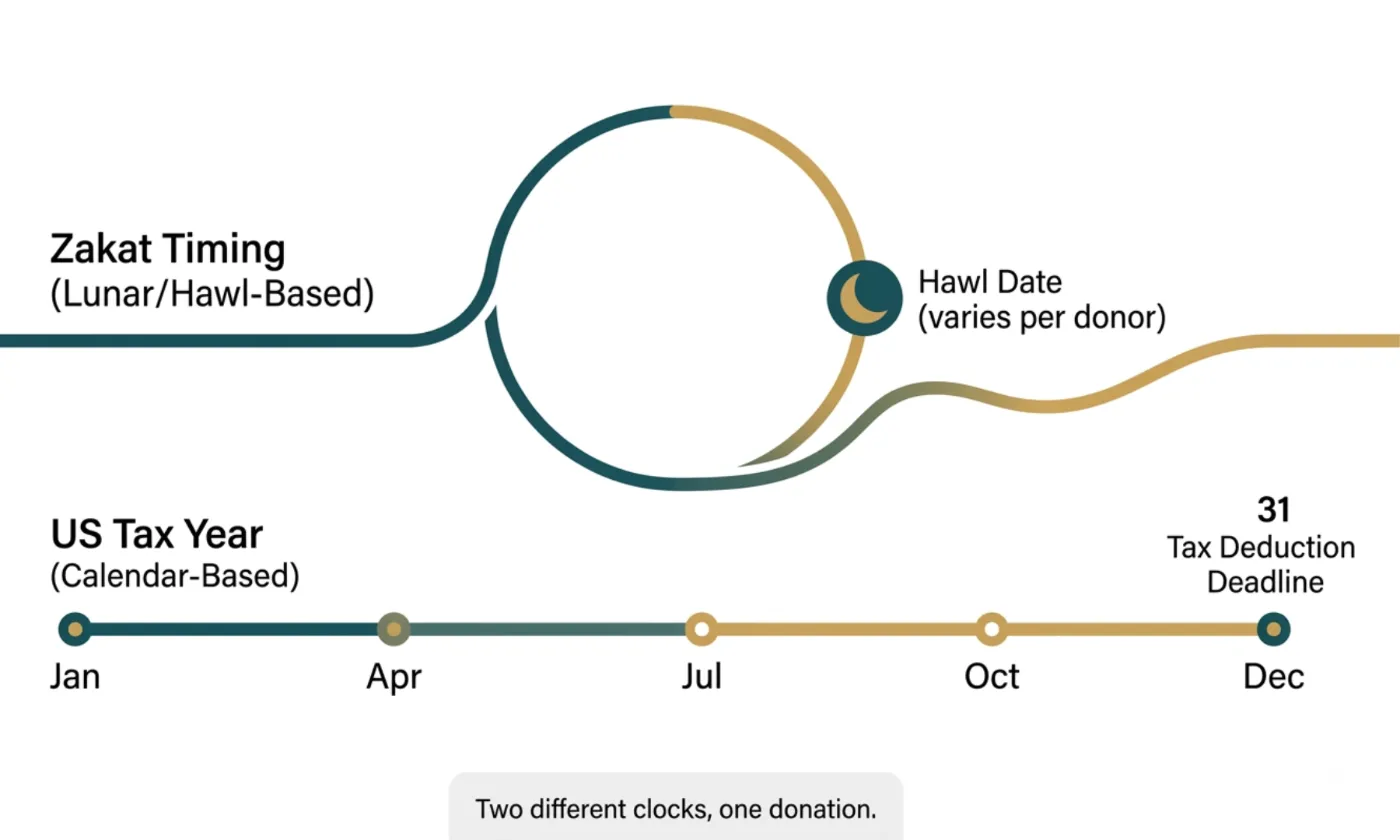
This image shows a comparison of zakat timing based on the lunar hawl cycle with the US calendar tax year and December 31 deduction deadline
A few things close that gap:
- State clearly on your donation page and receipt that a December gift is tax-deductible for that calendar year regardless of when the donor’s zakat became due
- Keep the fund-code separation described earlier in this checklist so a December zakat gift is still tracked as zakat, not folded into general year-end donations
- If your organization sends a year-end giving reminder, mention both angles directly: the tax deadline and the fact that zakat timing is personal to each donor’s own hawl, so there is no religious requirement to wait until December
None of this changes your 501(c)(3) reporting obligations. It just means your year-end communications should speak to two different donor motivations at once, the tax-deductible donation deadline and the religious obligation, instead of treating them as the same thing.
Frequently Asked Questions
Q1. What is the difference between 501(c)(3) compliance and Islamic financial accountability?
501(c)(3) compliance refers to IRS rules that all US tax-exempt organizations must follow, including annual filing and public disclosure. Islamic financial accountability refers to how a nonprofit handles zakat, sadaqah, and waqf funds according to Islamic principles, which the IRS does not regulate directly.
Q2. Do I need a Shariah advisory board to be considered transparent?
Not necessarily. Larger organizations often maintain one, but smaller nonprofits can build trust by publishing a written zakat distribution policy and naming who reviews fund allocation, even without a formal board.
Q3. How often should a nonprofit update its transparency page?
At minimum, once a year after your Form 990 is filed. Organizations running active zakat or sadaqah campaigns often update more frequently, particularly after Ramadan and again before Q4.
Q4. What happens if my nonprofit misses a Form 990 filing deadline?
A single late filing usually triggers a penalty but not loss of status, since form 990 requirements allow for reasonable cause exceptions. Missing three consecutive years results in automatic revocation of tax-exempt status, which must be addressed through reinstatement procedures with the IRS.
Q5. Is zakat fund segregation legally required by the IRS?
No, the IRS does not require zakat-specific accounting. It is a best practice rooted in Islamic financial accountability, expected by donors who want to verify their zakat reached eligible recipients.
Q6. Can a small nonprofit earn a Candid Seal of Transparency?
Yes. Candid’s seal program is free and available to nonprofits of any size, based on the amount of information shared on their public profile, including financials, leadership, and impact metrics.
Q7. What is the easiest first step toward better transparency reporting?
Publish your most recent Form 990 and a plain-language program spending breakdown on a dedicated page linked from your main navigation. This single step resolves the most common donor research friction.
Q8. How does donor trust from transparency affect recurring giving?
Donors who can quickly verify fund usage are more likely to move from one-time gifts into recurring commitments, since transparency removes the hesitation that often prevents a first-time donor from becoming a sustained one.
Q9. Should zakat given in December be treated differently from a regular year-end donation on a tax receipt?
Not on the receipt itself. The IRS treats a December zakat payment the same as any other cash donation for deduction purposes. Internally, though, it should still be tracked and coded as zakat rather than general giving, so your fund segregation stays accurate even though the tax paperwork looks the same.
Closing Thought
Nonprofit transparency is not a report you publish once a year and forget. For Muslim nonprofits, it is a standing answer to a question every donor asks silently before they give: will my zakat, my sadaqah, my donation actually go where you say it will. Meeting IRS requirements answers half of that question. Showing your work on Islamic financial accountability answers the other half. Organizations that do both, clearly and consistently, are the ones donors keep coming back to.