
If your mosque, Islamic school, or Muslim-led nonprofit operates in California, there is a state employment law that applies to you whether you have two employees or two hundred. It is called SB 294, the Workplace Know Your Rights Act, and it does not make an exception for religious organizations. Not for houses of worship, not for faith-based schools, not for community centers run entirely by volunteers.
This is the kind of law that tends to slip past nonprofit boards. Most Islamic centers in California are run by a small group of trustees and maybe one paid administrator already juggling facilities, programming, and finances. Employment compliance is rarely anyone’s full-time job. SB 294 has two statutory dates attached to it, and both have already passed. That does not mean the obligation is over. It means the law is now in its ongoing phase, and organizations that have not addressed it are currently out of compliance, not simply running late on a deadline.
Here is what the law actually requires, why it applies to you even if you consider your organization exempt from most labor rules, and what SB 294 nonprofit compliance looks like right now, months after the original dates came and went.
What SB 294 Actually Requires
SB 294, signed into law by Governor Newsom on October 12, 2025 and codified at California Labor Code sections 1550 through 1559, requires California employers to give every employee a standalone written notice describing specific workplace rights. The notice has to cover things like the right to workers’ compensation benefits, the right to advance notice before immigration authorities inspect I-9 employment records, protection against retaliation tied to immigration status or E-Verify reporting, the right to organize or engage in workplace activity related to labor rights, and constitutional protections that apply when interacting with law enforcement at the workplace.
The word standalone matters here. You cannot bury this inside your existing employee handbook or staple it to an offer letter. It has to exist as its own document, separate from anything else you distribute.
The California Labor Commissioner has published an official template notice, and it is available in more languages than most employers realize, including English, Spanish, Chinese, Tagalog, Vietnamese, Korean, Hindi, Urdu, and Punjabi. Employers can use that template directly or draft their own version, as long as it covers everything the law requires.
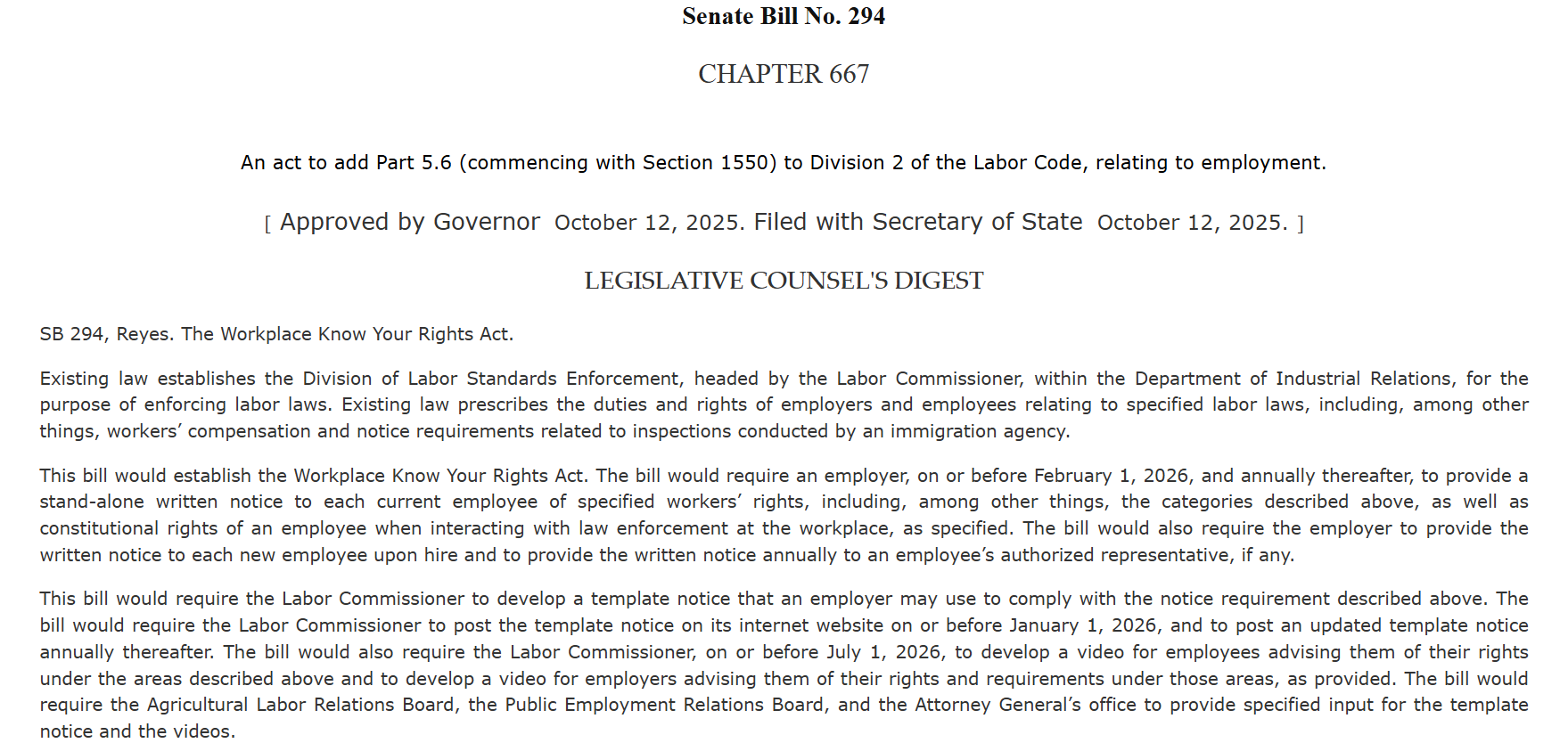
SB294, Chapter 667 Snapshot from California Government Official site
Why There Is No Religious Exemption
A lot of nonprofit leaders assume that because their organization is faith-based, it falls outside the reach of general employment statutes. That assumption is usually wrong, and it is definitely wrong here. SB 294 does not carve out any exception for religious employers. A masjid with a full-time Imam and a part-time office coordinator has the same notice obligation as a tech company in San Francisco.
This matters more for Muslim organizations because of who typically works at them. Many mosques and Islamic schools employ custodial staff, kitchen staff who prepare food for Jummah or community iftars, part-time teachers, and administrative help who may not be native English speakers, some of them recent immigrants. The law’s language around immigration-related workplace rights was written with exactly this kind of workforce in mind, so the compliance stakes are not just about avoiding a fine. They are about whether your staff actually understand protections that already exist for them.
Where Things Actually Stand Right Now
This is the part that gets confused most often, so it is worth being precise about it. SB 294 required the first Know Your Rights notice to go out to all current employees by February 1, 2026, and required the emergency contact opt-in by March 30, 2026. Both dates are behind us.
If your organization already handled both, you are not done. The notice requirement repeats every year, so the next cycle falls on or before February 1, 2027, and every February after that. If your organization has not addressed either requirement, the deadline passing does not remove your obligation or reduce your exposure. It means the organization has been out of compliance since whichever date it missed, and the fix is to act immediately rather than wait for a new date. There is no grace period for organizations that missed the original window.
For any employee hired after March 30, 2026, both obligations apply at the moment of hire, not on a future compliance date. This means the emergency contact opt-in and the written notice are now a standard part of onboarding for every new hire your organization brings on, indefinitely. If your onboarding paperwork has not been updated to include both, every new hire since March 30 represents an open compliance gap.
The Labor Commissioner’s office has stated it is actively working with employers to promote compliance with 2026 labor law changes, and enforcement authority rests with both the Labor Commissioner and public prosecutors. There is no indication that enforcement is winding down because the initial deadlines have passed. An organization that missed the original notice date and still has not corrected it is carrying more risk than one that simply distributed the notice a few weeks late back in February, since the exposure keeps accumulating the longer the gap sits unaddressed.
What Has to Be in the Notice
The written notice has to describe several categories of rights, and the Labor Commissioner’s model notice already covers each one. At minimum, employees need to be informed about:
- Their right to workers’ compensation benefits, along with contact information for the Division of Workers’ Compensation
- Advance notice requirements before immigration agencies inspect I-9 records
- Protection against retaliation connected to immigration status, including misuse of E-Verify
- Their right to organize or engage in concerted workplace activity
- Constitutional protections, including Fourth Amendment protection against unreasonable searches and Fifth Amendment due process rights, that apply when interacting with law enforcement at the workplace
- A list of the state agencies that enforce these rights, so an employee knows where to go if something is violated
- Any other legal developments the Labor Commissioner decides are relevant, which gets folded into the annual template update
You do not have to write this from scratch. Pulling from the state’s official template and adapting the delivery method to fit how your organization communicates with staff is the more efficient path for most small nonprofits. For an organization sorting out what SB 294 nonprofit compliance actually looks like in practice, the fastest route is starting with the current model notice, cross-checking it against your active employee roster, and customizing only where your staffing setup genuinely differs from a typical office.
Delivery and Language Requirements
This is where a lot of Muslim nonprofits will need to think a little harder than a typical office employer would. The law requires the notice to be delivered in whatever manner you normally use to reach employees, as long as it can reasonably be expected to arrive within one business day. Email, text message, and personal handoff are all acceptable.
The language piece is genuinely good news for a lot of Muslim organizations. The notice needs to go out in the language you normally use to communicate with an employee, and one they actually understand, if a state template exists in that language. Urdu and Hindi are both already official template languages, alongside Punjabi. If your mosque employs staff whose primary language is one of these, there is no reason to hand them an English-only notice they cannot fully understand.
The Emergency Contact Provision and Why It Matters Here
This part of SB 294 was clearly written with the current immigration enforcement climate in mind, and it is worth taking seriously rather than treating as boilerplate paperwork. The law gives employees the right to designate a person who will be contacted if they are arrested or detained at work, or during working hours, when the employer has actual knowledge of it.
For a Muslim organization with staff who may be undocumented, on visas, or simply unfamiliar with their workplace rights, offering this option is not just a legal box to check. It gives staff a real mechanism that matters in a moment of crisis. A generic emergency contact field already sitting in an old HR file does not satisfy this requirement. The law needs a specific, dated opt-in where the employee explicitly indicates whether that contact should be notified in the event of an arrest or detention.
If your part-time custodian or your Islamic school’s kitchen coordinator has never been asked who should be called if something happens to them at work, this conversation should have already happened for every current employee. For anyone hired since March 30, 2026, it needs to happen as part of their onboarding, without exception, going forward.
If your board is reading this and realizing the notice was never distributed, or the emergency contact opt-in never happened, the right response is not to wait for anything. Distribute the notice now, run the opt-in now, and document the date for every employee. A late correction closes the gap and shows good faith if the organization is ever questioned. Waiting longer only extends the window of noncompliance, and for the emergency contact provision, the penalty runs per day, so delay carries a direct cost.
Recordkeeping
SB 294 requires employers to keep records showing compliance for three years, including the date each notice was distributed to each employee. This is a simple administrative habit, but it is also the piece that gets skipped most often by small nonprofits that do not have a dedicated HR system. A shared spreadsheet with employee name, notice date, and delivery method is sufficient for most organizations this size. What matters is that the record exists and can be produced if the state ever asks for it.
Penalties
The financial exposure here is not theoretical. Employers who fail to provide the required notice can face penalties of up to $500 per employee per violation. The emergency contact provision is steeper: up to $500 per employee per day the violation continues, capped at $10,000 per employee. For a small Islamic center running on donations, a compliance gap that goes unnoticed for months can turn into a real financial hit, on top of the reputational cost of a state labor complaint against a religious institution.
Run the math on a mid-sized mosque with fifteen employees. An emergency contact gap that has quietly continued since March, multiplied across that many staff on a per-day basis, adds up fast. That is money that would otherwise go toward programming or the building fund, lost to a paperwork gap a single afternoon of HR work could have closed months ago.
The law also includes anti-retaliation protections, meaning an employee cannot be disciplined or pushed out for asking about their rights under this act or helping a coworker exercise theirs.
A Practical Starting Point for Your Board
If your organization has not fully addressed this, here is a sequence to work through immediately, not on some future date:
- Pull the current Know Your Rights template and check whether a version exists in your staff’s primary language
- Identify every current employee, including part-time custodial, kitchen, and teaching staff, since hours worked does not matter
- Distribute the notice today if it has not already gone out, and log the date for each employee
- Run the emergency contact opt-in today for every current employee who has not completed one
- Update new hire onboarding so both requirements are automatic for anyone hired going forward
- Set a recurring annual reminder ahead of the next February 1 cycle
- Confirm your recordkeeping actually captures the date and method per employee, not just a general note it was done
Frequently Asked Questions about SB 294
Q1. Is SB 294 only for Muslim organizations, or does it apply to everyone?
It applies to every California employer, regardless of religion, size, or mission. It was not written for Muslim organizations specifically. A church, a synagogue, a secular nonprofit, and a for-profit business all fall under it the same way, with no carve-out based on religious identity.
Q2. Does this law apply to nonprofit organizations in California?
Yes. Nonprofit status does not exempt an organization from SB 294. If your mosque, Islamic school, or Muslim charity has employees in California, the requirements apply regardless of tax-exempt status.
Q3. We missed the February and March 2026 deadlines. Is it too late to comply?
No. Those dates were the original statutory triggers, not a closing window. The obligation continues, and fixing it now is far better than staying out of compliance. Your organization remains exposed for the period it was noncompliant, but acting immediately stops that exposure from growing.
Q4. Do volunteers count as employees under this law?
Generally no. SB 294 is built around the employer-employee relationship. Unpaid volunteers, including most mosque board members, typically fall outside its scope. Anyone your organization pays as staff, part-time or hourly included, is covered.
Q5. Does the notice have to be in English?
Not necessarily. It has to go out in the language you normally use with an employee, and one they understand, if a state template exists in that language. Urdu, Hindi, and Punjabi are already available, so English-only is often not the best option for a diverse Muslim nonprofit staff.
Q6. What happens if we are audited or a complaint is filed?
The Labor Commissioner and public prosecutors both enforce SB 294. Dated records of when each employee received the notice and completed the opt-in are what demonstrate compliance. Without that documentation, even an organization that technically distributed the notice may struggle to prove it.
This Is Not Legal Advice
Everything above is meant to help your board understand what SB 294 involves and why it applies to Muslim nonprofits in California without exception. It is not a substitute for legal counsel, and nothing here should be treated as a final compliance answer for your organization. The details that matter most, like how a particular staffing arrangement affects your obligations, depend on facts specific to your organization. If your board has questions about your specific situation, the right next step is a conversation with a licensed California employment attorney who can review your actual employee records and policies.
Staying Ahead of Regulatory Changes Like This
Laws like SB 294 rarely get written with Muslim nonprofits in mind, but they apply anyway, and the organizations that stay informed are the ones that avoid getting caught off guard by a fine or a labor complaint. Mission Managers works with Islamic nonprofits and mosques across the country on the communications side of running an organization, which means we track shifts like this one, not to offer legal advice, but so the nonprofits we work with are never the last to know.