
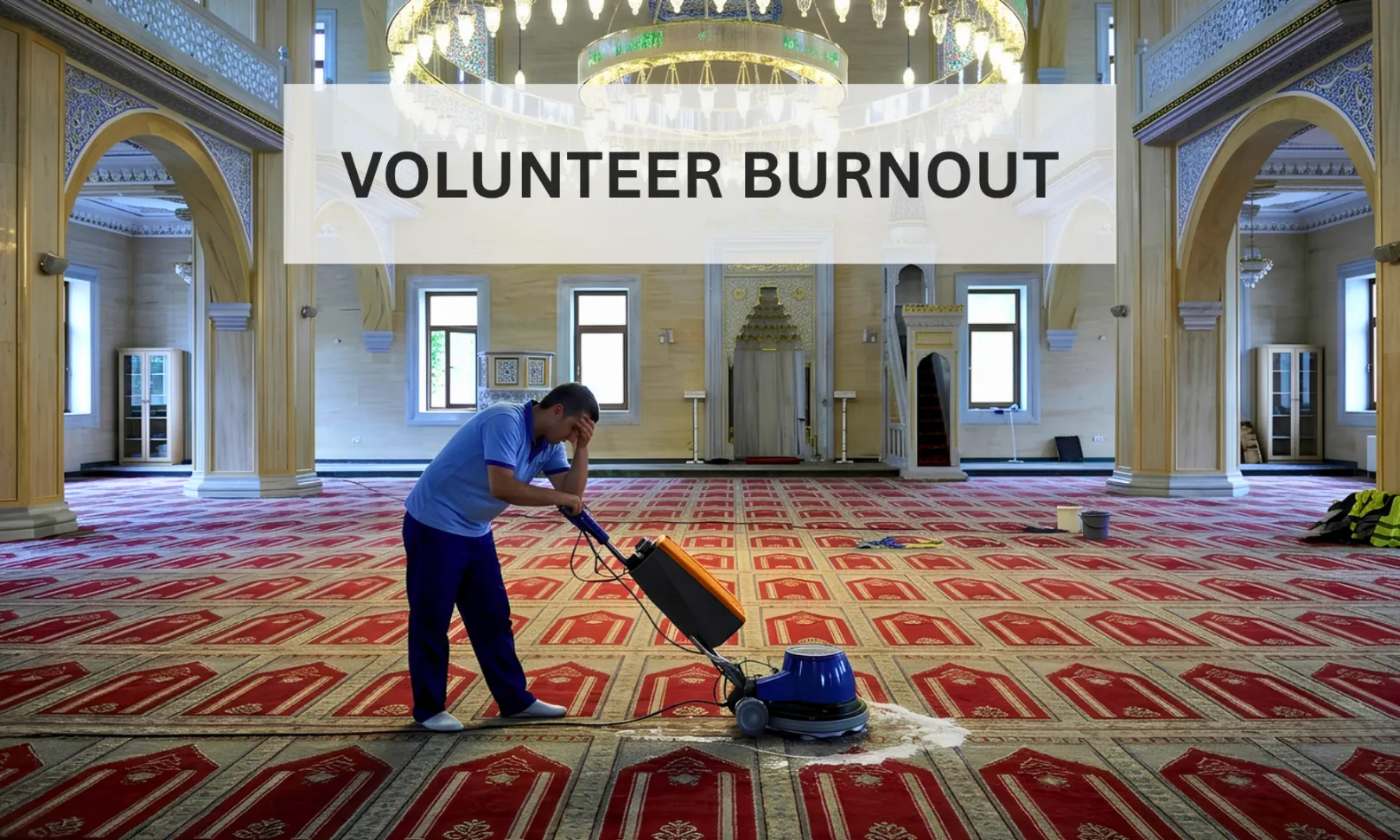
Volunteer burnout does not announce itself at a mosque the way it does at a corporate nonprofit with an HR department and an exit interview. It shows up as a slow disappearance. The brother who used to run the Friday parking crew stops answering the committee group chat. The sister who organized every Ramadan iftar for six years suddenly cannot commit to a single date in Shaban. By the time the board notices, the person is already gone, and so is the institutional knowledge that lived only in their head.
We have sat in enough mosque board meetings to know this pattern repeats every single year, almost on schedule. It is not a mystery and it is not a coincidence. It is a structural problem, and it is fixable once the board can name it early instead of discovering it after the fact.
Why Volunteer Burnout Looks Different at a Mosque
Most articles on volunteer burnout are written for organizations with a paid volunteer coordinator, a recognition budget and a pipeline of new sign-ups. That is not the reality for most Islamic centers in the US. A typical mosque runs on the same eight to twelve people for everything from event setup to social media to the weekend school. When one of them steps back, there is no backup layer. There is just a gap that someone else has to absorb on top of what they are already doing.
There is also a cultural layer that makes mosque volunteer burnout harder to catch. Complaints about workload often get reframed as a test of faith rather than a real operational issue. Someone who is exhausted will say “it’s for the sake of Allah, I can’t complain” instead of telling the board they need help. That framing is sincere and it is also exactly why burnout goes unreported until the volunteer simply stops showing up.
7 Warning Signs Your Board Should Not Ignore
1. The same five or six names show up to every event
If your committee roster has thirty names on paper but the same handful of mosque volunteers physically show up to set up chairs, run the kitchen and handle registration every single time, that is not dedication. That is a warning sign that the workload is concentrated on people who are one bad month away from quitting.
2. Response time in the committee group drops
A volunteer who used to reply within the hour now takes three days to answer a simple logistics question. This is one of the earliest and most reliable warning signs, and it is easy to miss because the person has not said anything is wrong.
3. Tasks get done, but the extra effort disappears
The event still happens, the food still gets served, but the volunteer who used to personally welcome new families at the door is now just handing out programs and leaving early. Quality drops before attendance does.
4. Ramadan volunteers vanish by the time Shawwal starts
Ramadan pulls in a wave of extra hands, then almost all of them disappear within weeks of Eid. If your mosque has no plan for what happens to that spike in energy after Ramadan, you are guaranteed to lose most of it, and the people who were already volunteering year round end up absorbing the load that the seasonal volunteers leave behind.
5. Frustration gets spiritualized instead of raised as a real problem
When a volunteer says something is “a test” instead of naming the actual issue, whether that is being asked to work every single Jummah without rotation or covering for three other people who stopped showing up, the board loses the chance to fix something that is genuinely fixable. Take these comments as data, not just as reminders to be patient.
6. One person becomes the only one who knows how something works
If your event registration, your social media login or your donor spreadsheet only lives in one volunteer’s head, you do not have a system. You have a single point of failure, and that person is carrying a weight that has nothing to do with generosity and everything to do with unmanaged risk.
7. Attendance drops at planning meetings before it drops at events
People stop showing up to the boring administrative meeting long before they stop showing up to the actual event, because the event still has a payoff and the meeting feels like extra unpaid work. A quiet planning meeting is often the first visible sign of it, weeks before anything else changes.
What Volunteer Burnout Actually Costs Your Mosque
Losing a volunteer is not just a scheduling problem. Volunteering and giving are connected in ways most boards underestimate. National research from Fidelity Charitable found that a majority of donors have also volunteered recently, and a large share started volunteering before they ever made a financial gift. A volunteer who burns out and drifts away is not just a missing pair of hands on Saturday morning. Over time, that person is also a donor relationship the mosque may be quietly losing.
The hours themselves carry real financial weight too. Independent Sector’s most recent Value of Volunteer Time report puts the value of a single volunteer hour at just over thirty six dollars nationally. A mosque running on a dozen active volunteers giving five hours a week is sitting on tens of thousands of dollars in annual labor value that nobody tracks on a balance sheet, and that nobody replaces easily once it walks out the door.
How to Catch It Before It Empties Your Committee
Start by writing down who actually knows how to do what. If only one person can run your event registration or manage your social pages, that is your highest risk point, and it needs a second trained person immediately, not eventually.
Build a real rotation before Ramadan starts, not after it ends. Decide in advance which tasks get handed to seasonal volunteers permanently and which stay with your core team, so the post-Ramadan drop-off does not land entirely on the same tired handful of people.
Ask directly instead of waiting for someone to say they are struggling. A short, private check-in with your most active mosque volunteers once a quarter will surface burnout months before it shows up as a resignation. If your mosque has not yet mapped out its full donor and volunteer engagement strategy, our guide on nonprofit marketing strategies for Muslim nonprofits walks through how volunteer retention and donor retention actually reinforce each other.
Burnout among mosque volunteers is not a sign that people care less. It is a sign that a small group has been carrying a structural gap for too long without anyone naming it. Catch the early signs, and you keep both the volunteers and the donors who came in behind them.
Common Questions About Volunteer Burnout
Q1. What is volunteer burnout?
It is the point where a volunteer’s energy, patience and commitment run out because the workload has been too heavy for too long without support or acknowledgment. At a mosque, it usually builds quietly for months before anyone notices.
Q2. What causes volunteer burnout at a mosque?
A small, unpaid core team carrying most of the work, a Ramadan spike that most seasonal volunteers do not continue after Eid, and a culture where raising a workload concern gets reframed as impatience rather than a real operational issue.
Q3. What are the signs to watch for?
Slower replies in the committee group, the same handful of names doing everything, tasks getting done without the extra care they used to get, and lower turnout at planning meetings before it shows up anywhere else. The full list of seven signs is above.
Q4. How do you prevent volunteer burnout?
Document who knows how to do what so no single person is a point of failure, build a rotation before Ramadan instead of after it, and check in privately with your core mosque volunteers every quarter instead of waiting for them to say something is wrong.
Q5. When should a mosque volunteer step back?
As soon as the work feels like an obligation with no room to say no, rather than a contribution they chose to make. A board that makes stepping back easy, without guilt, usually gets that person back later as a donor or a part time volunteer instead of losing them completely.