
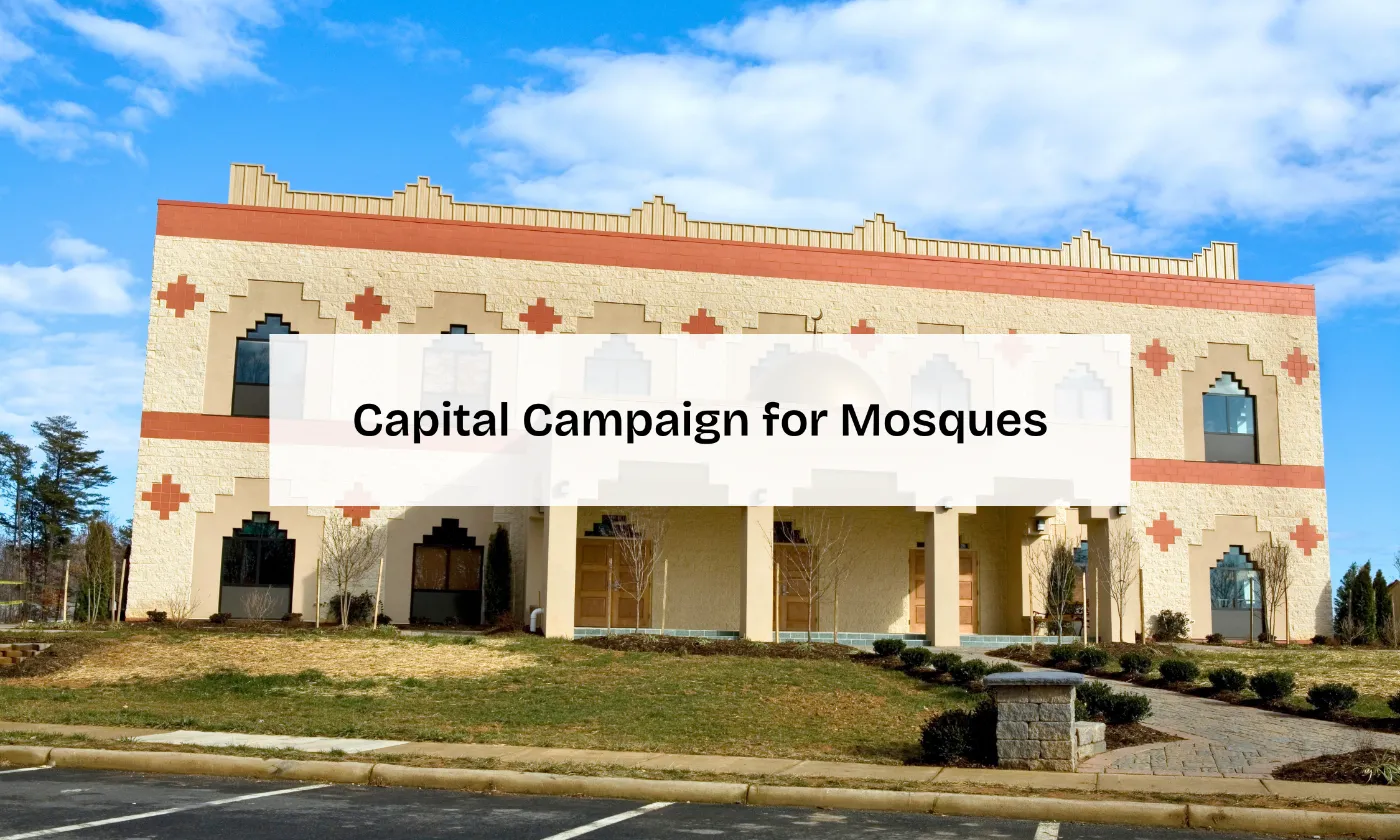
A capital campaign is how most mosques and Islamic centers in the US actually pay for land, construction or a major renovation, and it looks nothing like a Ramadan appeal or a Jummah collection. It runs on a different timeline, a different set of donors and a different sequence of asks, and getting that sequence wrong is the single biggest reason masjid building projects stall halfway through construction with the walls up and the money gone.
This piece walks through the six steps that separate an effort that hits its number from one that quietly runs out of momentum in year two.
What a Capital Campaign Actually Is (and Why It Is Different From Regular Fundraising)
A capital campaign is a time-bound fundraising effort built around one specific, large goal, usually construction, land purchase, a major renovation or an endowment, rather than ongoing operating costs. It has a defined start date, a defined end date and a dollar figure attached to a physical outcome the community can see.
That is the opposite of how most masjids raise money day to day. Weekly Jummah collections and annual Ramadan campaigns fund operations. A fundraising push for a new prayer hall, a school wing or a community center is a separate effort with its own goal, its own timeline and, in most cases, its own committee.
Step 1: Run a Feasibility Study Before You Set a Goal
Before a board announces a number, a capital campaign feasibility study should tell them whether that number is realistic. This is a short round of confidential interviews, usually 15 to 25 conversations with major donors, community leaders and long-time board members, asking a simple question: if we asked you to give toward this project, at what level, and how would you want to be asked.
Skipping this step is the most common reason capital campaigns miss their target. A board picks a round number that sounds impressive, announces it publicly, then discovers mid-campaign that their top five donors were only ever willing to give a third of what the plan required. The Association of Fundraising Professionals lists a feasibility study among the first readiness checks a board should complete, precisely because it catches a mismatch between the goal and the donor base six months before launch instead of six months into the campaign, when there is still time to adjust the scope, the timeline or the ask.
For a masjid specifically, this is also where you learn something a generic feasibility study would miss: whether your community sees this building project as Sadaqah Jariyah, an ongoing charitable act that keeps generating reward after the donor has passed, or as something closer to routine operating expense. That framing changes how large donors respond to the ask, and it is worth asking about directly during the study.
Step 2: Build a Case for Support That Donors Actually Remember
A case for support is the document that answers one question for every donor: why this project, why now and why should I be the one to fund it. It is not a brochure and it is not a mission statement. It is the argument, written down, that your campaign committee and your major gift solicitors will use in every single conversation.
A strong case for support for a masjid building fund does three things. It states the specific need in concrete terms (a prayer hall that fits 400 people instead of the current 180, a Sunday school wing that stops classes from running in a converted storage room). It shows the community has already committed, usually through early lead gifts or board pledges, because donors give to momentum, not to blank pages. And it frames the gift in language that resonates religiously, tying a physical building to something that keeps benefiting the community long after the donor is gone, which is precisely what Sadaqah Jariyah means.
Skip generic language here. “Help us build a better future” could describe any nonprofit in any country. “This wing lets 300 children learn Quran without waiting for a Saturday time slot” is specific enough that a donor can picture exactly what their gift does.
Step 3: Get the Zakat-Eligibility Question Right Early
This step trips up more masjid building campaigns than any other, and it has nothing to do with fundraising mechanics. Most Islamic scholars do not consider mosque construction or building fund donations Zakat-eligible, since Zakat is generally restricted to categories of recipients defined in the Quran, and a building does not fall into those categories the way direct aid to an eligible individual does. Sadaqah, on the other hand, has no such restriction.
Getting this wrong at the point of the ask creates real confusion. A donor who planned to fulfill their annual Zakat obligation through your campaign, then learns later that the gift did not count toward Zakat, feels misled even if nobody intended to mislead them. State clearly, in the case for support and in every solicitation conversation, that gifts to the building fund are Sadaqah rather than Zakat. Donors who specifically want their Zakat to go toward the masjid’s other programs, feeding programs, scholarship funds or direct aid, can be routed there instead, and both funds stay clean and both donors stay confident in how their money was used.
Step 4: Build Your Gift Range Chart
A gift range chart maps out how many gifts you need at each dollar level to hit your total goal, and it is the single most useful planning document in the entire campaign. Capital campaign fundraising is heavily top-weighted. The lead gift alone typically needs to represent 20 to 25 percent of the total goal, and the top ten to fifteen gifts combined often account for more than half.
For a $2 million masjid expansion, that might look like one lead gift of $400,000 to $500,000, four to six gifts in the $100,000 to $200,000 range, a dozen gifts between $25,000 and $50,000 and then a much broader base of smaller gifts filling out the remainder during the public phase. Building this chart before you start asking anyone for money tells you immediately whether your goal is realistic given who is actually in your donor base, or whether it needs adjusting before launch.
Step 5: Run the Quiet Phase Before Anyone Announces Anything
The quiet phase, sometimes called the silent phase, is where a capital campaign is genuinely won or lost, and most masjid boards underestimate how much of the total goal needs to be secured before going public. CCS Fundraising notes that this phase is typically where the majority of a campaign’s funds get raised while marketing communications stay quiet, with many organizations aiming to reach a substantial share of their goal, often in the range of 60 to 90 percent, before any public announcement.
Quiet does not mean secret. During this phase, board members, the Imam and campaign volunteers meet privately with the community’s largest potential donors, present the case for support directly and secure lead gifts one conversation at a time. What stays quiet is the specific dollar goal, not the existence of the project. Once the largest gifts are locked in and the campaign has real momentum behind it, the board moves to Step 6 with a number they already know they can hit.
Step 6: Launch the Public Phase and Close the Gap
The public phase opens the campaign to the entire congregation and the wider community, usually through a kickoff event, Jummah announcements, social media and a mobile-friendly donation page with a clear goal thermometer. By this point, the campaign has already secured most of its total through quiet-phase major gifts, so the public phase is about filling the remaining gap with a large number of smaller, broadly distributed gifts.
This is also where the same QR code and mobile-giving infrastructure that works for Ramadan campaigns applies directly to a building fund. A congregant who is ready to give $50 or $100 toward the new prayer hall should be able to do it in under a minute from their phone during Jummah, without needing cash or a checkbook, and without waiting for a follow-up call from the campaign committee.
When to Bring In a Capital Campaign Consultant
Not every masjid needs an outside capital campaign consultant, but a few situations make outside help worth the cost. If the fundraising goal exceeds what your current board has ever raised before, if nobody on the committee has run a major gift solicitation conversation, or if the feasibility study itself feels like something your team cannot conduct objectively (donors are often more candid with an outsider than with a board member they know personally), a consultant earns their fee back many times over by preventing a mis-set goal or a poorly sequenced ask.
Smaller campaigns, particularly ones under $500,000 with a board that already has strong relationships across the congregation, can often run the full six-step process internally, as long as someone owns the feasibility study, the case for support and the gift range chart as dedicated deliverables rather than informal conversations.
For a broader look at what fundraising channels are working for Muslim nonprofits right now, including how LaunchGood and QR-code giving fit into a mosque building fund specifically, see what’s actually working for Muslim nonprofit fundraising campaigns in 2026. And if part of the building project will be funded through institutional or government grants alongside donor gifts, grant writing support can run in parallel with the quiet phase rather than after it.
Frequently Asked Questions
Q1. How long does a typical masjid capital campaign take?
Most run 18 to 36 months from feasibility study to final gift, though the quiet phase alone can take six to twelve months depending on how quickly lead gifts come together.
Q2. What size masjid needs a capital campaign versus just saving from operating funds?
Any project large enough that it cannot be absorbed by regular Jummah and Ramadan giving without disrupting operations, typically anything above $250,000 to $300,000, benefits from this dedicated fundraising structure.
Q3. Can Zakat be used for masjid building fund donations at all?
Most scholars say no, since building construction falls outside the eight categories of Zakat-eligible recipients. Donations to a building fund should be framed as Sadaqah instead, and this should be stated clearly wherever the campaign asks for gifts.
Q4. What percentage of the goal should be raised before going public?
Fundraising consultants generally recommend somewhere between 60 and 90 percent secured during the quiet phase before a public launch, with the exact figure depending on the size of the donor base and how top-heavy the gift range chart is.
Q5. Do we need a capital campaign consultant if our board has never run one before?
Not automatically, but a first-time campaign benefits from at least a consultant-run feasibility study, since donors tend to give more candid answers to a neutral outsider than to a board member they know personally.
Q6. How is a case for support different from a regular fundraising appeal?
A case for support is a foundational document used across the entire campaign by every solicitor in every conversation. A regular appeal is a single ask, usually shorter, tied to one campaign or one moment rather than the full multi-year effort.
Q7. Should online donation forms accept both Zakat and Sadaqah for a building campaign?
The building fund itself should be positioned as Sadaqah only. If the masjid also runs other Zakat-eligible programs, a separate donation option should exist so donors are not confused about where their Zakat is actually going.
Q8. What happens if the quiet phase does not reach 60 percent of the goal?
Most experienced campaign consultants recommend delaying the public launch and adjusting either the goal, the timeline or the gift range chart rather than launching publicly on an under-secured base, since a public campaign that visibly stalls is harder to recover from than one that launches later with real momentum behind it.