
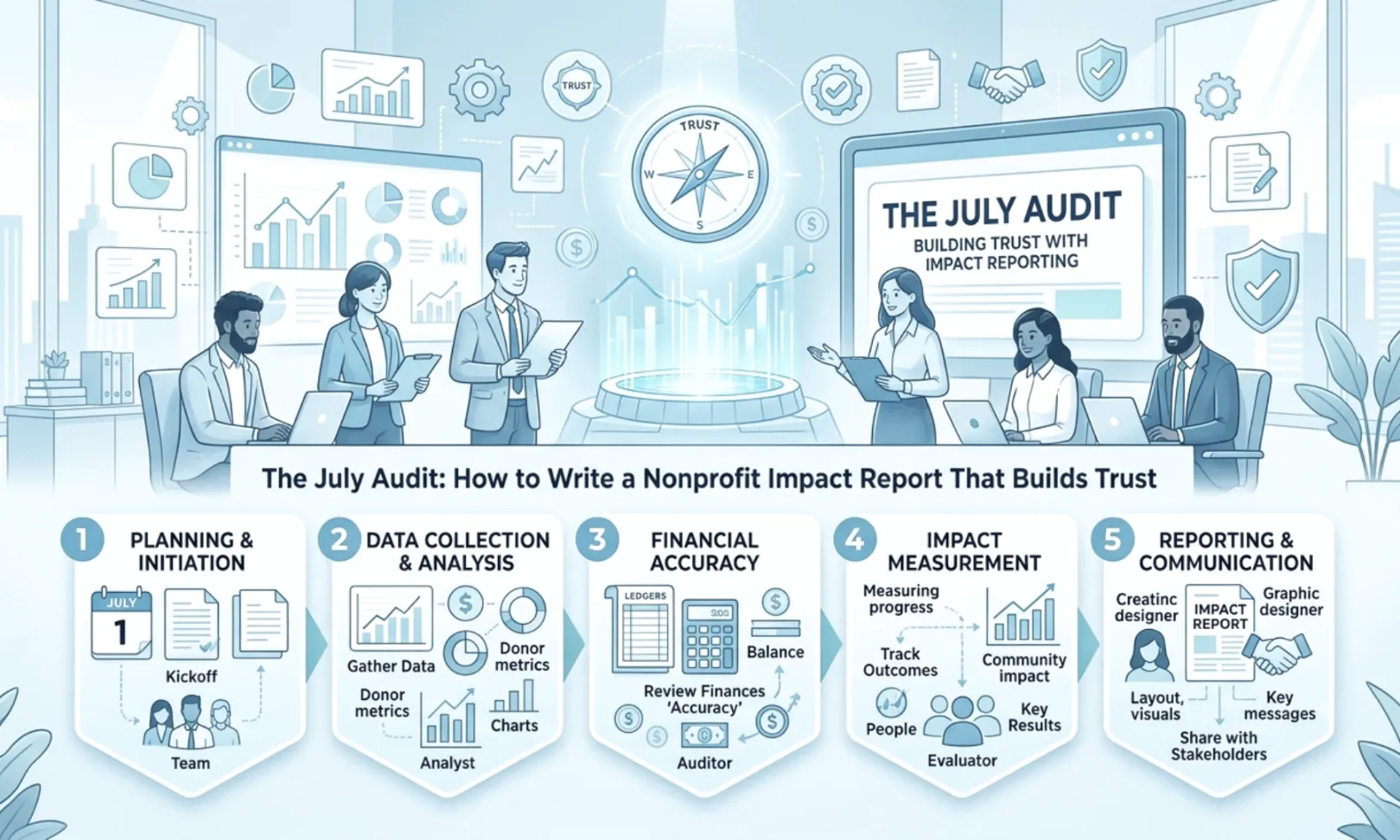
By the time July rolls around, most US Muslim nonprofits have already run their biggest campaign of the year. Ramadan came, Zakat and Sadaqah poured in, Eid closed the month out and then everything went quiet. No campaign is running. No urgent appeal is landing in inboxes. This is usually the point where a nonprofit impact report either gets written properly or gets skipped entirely and that choice matters more than most teams realize.
It is not a formality you owe your donors once a year. Done right, it is the single document that decides whether a Ramadan donor sees themselves as a one-time giver or as someone invested in what happens next. Done poorly, or not at all, it confirms the worst assumption a lapsed donor can make: that nobody is tracking what their money actually did.
This piece walks through what belongs in a mid-year update like this, why the timing matters specifically for Muslim-led organizations and how to write one that reads like an update between partners rather than a corporate summary nobody asked for.
Why July Is a Different Kind of Reporting Window
Most nonprofit sector advice on impact reporting assumes a calendar-year rhythm: campaign, report, repeat, with the big reporting push landing in December. That framework does not map cleanly onto how Muslim nonprofits actually raise money.
Ramadan is a lunar event, so it lands at a different point on the Gregorian calendar every year, but the pattern is consistent. The bulk of annual giving arrives in a concentrated window, often followed by Eid and then there is a long stretch, sometimes five or six months, before the next major giving season begins around GivingTuesday and Q4. July usually sits in the middle of that stretch.
That gap is exactly where donor relationships either strengthen or quietly dissolve. A donor who gave generously in February or March has had months of silence by July, aside from a receipt and maybe an automated thank-you. If the only other communication they get is another ask in November, the relationship never had a chance to become anything more than a transaction. A mid-year report interrupts that silence at precisely the point where it starts to matter.
Nonprofit Impact Report vs Annual Report: Why the Distinction Matters Here
These two terms get used interchangeably, but they are not the same document and mixing them up leads to a bloated, unfocused mid-year piece.
An annual report is comprehensive. It typically includes audited or reviewed financials, a full list of programs and activities, board and leadership information and sometimes a donor listing. It is thorough by design and it usually goes out once a year.
This kind of report is narrower on purpose. It focuses on outcomes, not operations: what did the money accomplish, who did it reach and what changed because of it. It is shorter, more visual and built to be read in a few minutes rather than studied like a filing.
For a July send, an impact report is almost always the right format. Donors do not need financial statements six months into the year. They need proof that the Ramadan gift they gave did what it was supposed to do. Save the full annual report structure for year-end, when audited numbers are actually available.
What Actually Belongs in a Mid-Year Nonprofit Impact Report
A strong donor impact report does four things and skipping any one of them is usually what makes a report feel hollow even when the writing is polished.
The numbers, stated plainly: How much came in during Ramadan, how it was allocated across programs and what percentage went directly to program work versus overhead. Donors do not need a spreadsheet. They need one or two sentences that answer “where did my money go” without making them do the math themselves.
A specific story, not a generic one: Pick one program, one location or one family and describe what actually happened with enough detail that it could not have been copied from a template. Vague language like “we helped families in need” reads as filler. A sentence naming the exact number of iftar meals distributed in a specific city or the number of Zakat-eligible families reached through a named distribution, does the opposite. It signals that someone tracked this closely enough to report it precisely.
A transparency note, especially for Zakat-designated gifts: Muslim donors care about fund segregation in a way that general nonprofit reporting advice rarely addresses. A short line confirming that Zakat was tracked and disbursed separately from Sadaqah, and roughly when distribution happened relative to Ramadan, closes a trust gap that most nonprofits never think to close. Read our full breakdown of 501(c)(3) and Islamic compliance reporting standards
A forward-looking sentence or two: Tell donors, briefly, what is coming next. This does not need to be a full Q4 preview. A single line about an upcoming program milestone or the next giving season gives the report a sense of continuity instead of reading like a closed chapter.
Building It From a Template Without It Sounding Like One
A nonprofit impact report template is genuinely useful as a starting structure, but the reports that actually build donor trust are the ones where the template disappears behind the specifics. The fastest way to spot a templated report is language that could apply to any nonprofit in any sector: “we are grateful for your continued support,” “together we are making a difference,” phrases that carry no information at all.
A practical way to avoid this: before writing a single sentence, pull three real numbers and one real name (a program name, a city, a partner organization) that are specific to this Ramadan cycle. Build the report around those four anchors instead of starting from a generic outline. The structure can absolutely follow a repeatable format each year. The content inside it should never be interchangeable with last year’s version.
If you want donor impact report examples to model this against, look outside the nonprofit sector for a moment. Public companies write shareholder letters the same way each quarter, same structure, entirely different numbers and stories every time. That is the standard worth borrowing: consistent format, never-repeated content.
Why This Matters More Than Most Teams Assume
Donor retention data backs this up directly. Sector-wide, the Fundraising Effectiveness Project has tracked overall donor retention hovering in the low-to-mid 40 percent range for years, while repeat donors who receive ongoing communication retain at significantly higher rates than first-time donors who hear from an organization only during active campaigns. The gap between those two numbers is largely explained by what happens, or does not happen, in the months between gifts.
A more recent benchmark makes the same point from a different angle. The 2026 Virtuous Nonprofit Fundraising Benchmark Report puts sector-average retention at just under 55 percent, with top-quartile organizations well above that. The difference between an average nonprofit and a top-quartile one is rarely a bigger budget. It is usually a more deliberate stewardship calendar and a mid-year impact report is one of the easiest pieces of that calendar to implement.
How the Mid-Year Report Fits Into a Bigger Stewardship Plan
A single report is not a stewardship strategy on its own. It works best as one deliberate touchpoint inside a longer sequence that starts right after Eid, not in July. Why Muslim nonprofit donors go quiet after Eid walks through the earlier stages of that sequence, including the close-the-loop thank you sent within two weeks of Eid and the shorter impact snapshot that typically goes out six to eight weeks later. The full mid-year report described here is the natural continuation of that snapshot, expanded once real program numbers are available.
If your team wants the exact stewardship sequence that leads into this report, download the three-email post-Eid stewardship sequence
The 2026 Compliance Angle Nonprofits Are Overlooking
Nonprofit impact reporting and IRS compliance are usually treated as separate workstreams handled by separate people, but they increasingly overlap. The IRS’s annual filing and disclosure requirements for 501(c)(3) organizations already require public availability of recent Form 990 filings and donor expectations around transparency have only grown stricter since. A mid-year impact report is not a replacement for that filing, but it does the work that a Form 990 cannot: it explains, in language a donor can actually read in two minutes, what the numbers on that filing mean in practice.
Nonprofits that treat these as connected, rather than separate obligations handled at different times of year, generally find that both get done more consistently, since the same underlying data (program spend, fund allocation, distribution timing) feeds both documents.
Language That Makes Donors Feel Like Partners, Not ATMs
Word choice carries more weight in a donor impact report than most drafts give it credit for. Two versions of the same fact can land completely differently.
“We spent your donation on food distribution” reads as a transaction being reported back. “Because of your Ramadan gift, 340 families received Zakat-eligible food support before Eid” reads as an outcome the donor helped create. The second version uses the donor’s own gift as the subject of the sentence instead of the organization’s spending.
A few practical shifts that reinforce this throughout the report:
- Use “because of you” or “your gift made possible” instead of “we were able to.”
- Name the donor’s contribution alongside the outcome, not in a separate thank-you paragraph disconnected from the results.
- Avoid passive voice in the impact sections. “340 families were reached” is weaker than “your Ramadan gift reached 340 families.”
- Keep the tone conversational. Most donors are reading this on a phone, often the same way they read the original campaign appeal.
A Simple Mid-Year Impact Report Structure You Can Reuse
For teams that want a repeatable format rather than starting from scratch each July, this structure covers everything above in a length most donors will actually finish reading:
- A one-line opener naming the specific outcome, not a generic greeting.
- The numbers, three at most, stated in plain language.
- One specific story, three to five sentences, naming a real program or location.
- A short transparency note on fund handling, particularly for Zakat.
- A one-sentence look ahead to the next season or milestone.
- A closing line that reinforces partnership language rather than a generic sign-off.
This is roughly 300 to 500 words for an email version, or slightly longer if it lives on a dedicated web page. Length is not the goal here. A tightly written, specific 400-word report will outperform a padded 1,200-word one almost every time, because donors are not looking for comprehensiveness in July. They are looking for proof that someone is paying attention.
Frequently Asked Questions
Q1. How is a nonprofit impact report different from a donor thank-you letter?
A thank-you letter acknowledges the gift itself, usually close to the time it was given. This kind of report follows up later, after there is enough program activity to report real outcomes. Thank-you letters confirm receipt. Impact reports confirm results.
Q2. Do small nonprofits need a mid-year impact report, or is this only for larger organizations?
Smaller organizations often benefit more, since donors of small and mid-sized nonprofits tend to have a closer, more personal relationship with the cause and notice silence more quickly. A short, specific report matters more here than a polished, lengthy one would at a larger organization with more resources.
Q3. What if program numbers are not fully finalized by July?
Report what is confirmed and note that a fuller breakdown is coming later in the year. It does not need to be exhaustive. Partial, accurate numbers sent on time build more trust than complete numbers sent months late.
Q4. Should a mid-year impact report include financial statements?
No. That belongs in the annual report or the Form 990 filing. A mid-year impact report should summarize spending in plain language, not reproduce line-item financials, which most donors will not read closely anyway.
Q5. How long should this kind of report be?
Short enough to finish on a phone screen. For email, 300 to 500 words is typical. For a dedicated webpage version, slightly longer is acceptable if it stays visual and scannable rather than dense.
Q6. Can the same impact report be sent to every donor, or does it need segmentation?
A base version can go to most donors, but segmenting by gift type, at minimum separating Zakat givers from general Sadaqah donors, allows for a more specific transparency note that matches how their particular gift was used.
Q7. Is a mid-year impact report necessary if the organization already sends a detailed year-end report?
Yes, because the two serve different purposes. A year-end report closes out the full year. A mid-year report interrupts several months of silence at the point where donor attention typically drops off, well before the year-end report is anywhere close to being sent.
Q8. What is the biggest mistake nonprofits make in mid-year impact reports?
Writing them from a generic template without swapping in specific, current numbers and stories. Donors can tell the difference between a report written for this year and one that was recycled with the date changed.
Q9. Should this kind of report include an ask for another donation?
Generally no. This report works best as a pure stewardship piece, separate from solicitation. Mixing a donation ask into an impact update tends to undercut the trust the report is meant to build, since it starts to look less like an update and more like a pitch.
Q10. How does a mid-year impact report affect Q4 fundraising results?
Donors who received a clear mid-year update tend to respond more warmly to Q4 or GivingTuesday appeals, since the relationship was maintained rather than restarted from a cold list. It shifts the Q4 outreach from a reintroduction to a continuation of an existing conversation.
Q11. Where should this report be published, email or website?
Both, ideally. Email reaches donors directly and drives higher read rates for something this timely, while a permanent version on the website gives prospective donors a public example of how the organization reports on its work.
Q12. What is the easiest way to start building a mid-year impact report each year?
Set a recurring reminder in June to pull three program numbers and one specific story before writing begins. Most of the difficulty in writing these reports comes from starting with a blank page rather than starting with real, current material already gathered.
Closing Thought
This report is not extra work layered on top of an already busy summer. It is the piece that determines whether a Ramadan donor spends the rest of the year thinking about your organization as a cause they gave to once or a partner they are still connected to. The version that works is rarely the longest or the most polished one. It is the one that proves, with specific numbers and a real story, that someone was paying attention to what their gift actually did.