
Neon One’s Generosity Report found that multi-year donors make up just 11.7% of a typical nonprofit’s donor base but account for 45% of total revenue, which is the financial cost of losing a donor after a single gift. Ramadan is often the one moment a year an organization has real momentum with a donor, and losing that momentum in the silence after Eid is one of the most avoidable failures in Muslim nonprofit fundraising.
This is a donor stewardship email templates plan built specifically for that window. Three emails, each with a job to do, spaced out over the ten to twelve weeks after Eid. Copy the structure, swap in your own numbers and stories, and send.
If you have not yet read why donors go quiet after Eid in the first place, that piece covers the reasoning behind this timeline in more depth. This page is the execution layer: the actual emails.
Why a Sequence, Not a Single Email
Most nonprofits default to one of two extremes after Ramadan. Either a single thank-you goes out and nothing follows until the next campaign, or the organization goes quiet entirely once the receipts are sent. Both produce the same result: a donor who assumes their gift landed somewhere and was never heard from again.
A donor communication plan built around three touchpoints solves this without requiring a full-time stewardship staff member. Each email in this sequence is short, on purpose. None of them ask for another donation. The entire point is to prove, three separate times, that someone is paying attention to what the donor’s gift did.
Donor Stewardship Email Templates Plan
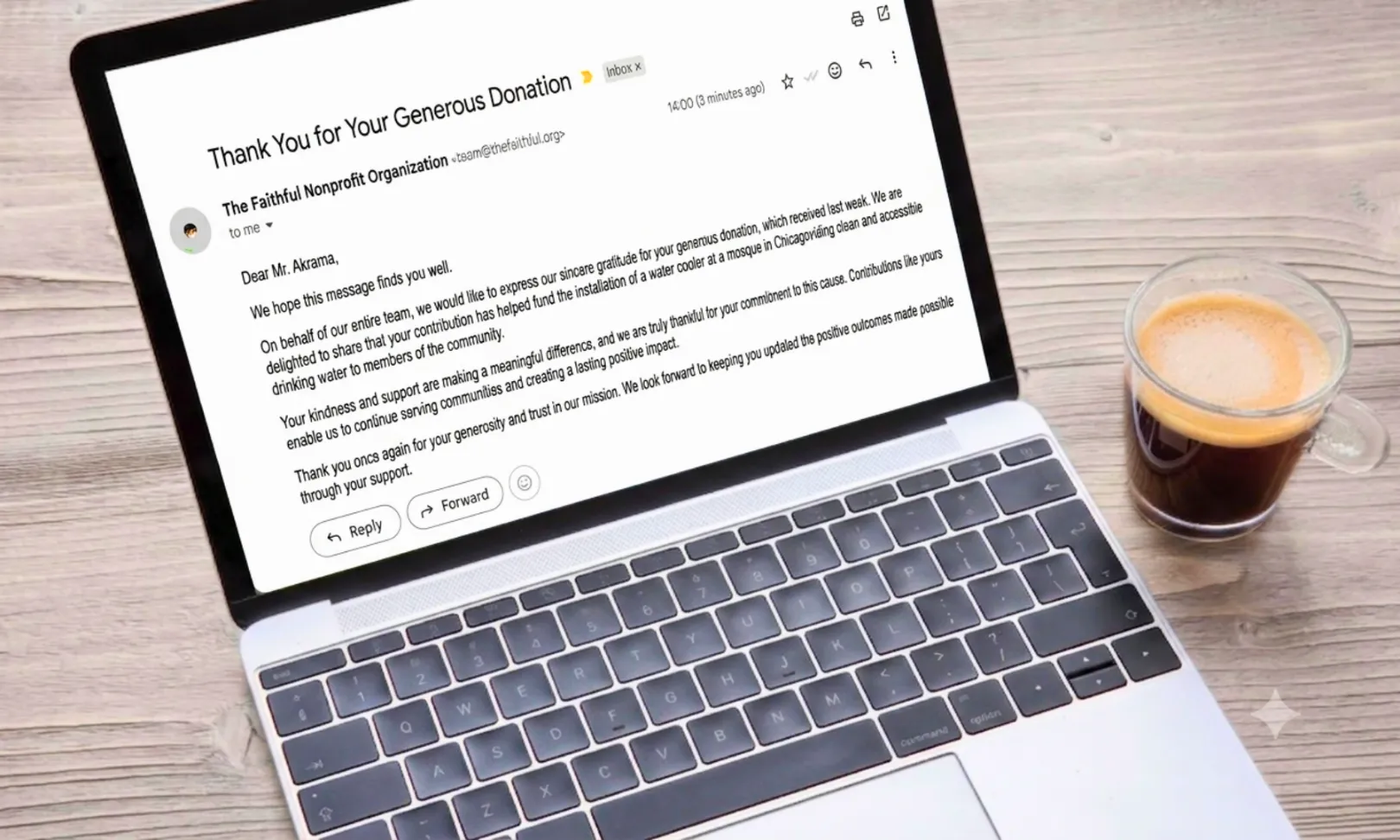
Email 1: The Close-the-Loop Thank You
When to send: Within three to five days of Eid, while the campaign is still fresh.
Purpose: Confirm the gift landed, close the emotional loop on the campaign and set expectations for what comes next. This is not the automated receipt. It is a separate and human-sounding follow-up.
Subject line options:
- Eid Mubarak, and thank you for what you made possible
- Your Ramadan gift, one more time before we move on
Body:
Eid Mubarak, [First Name].
Ramadan moved fast this year, and I wanted to take a moment before we fully move into the rest of the year to say thank you, properly, for your gift during [Month/Year].
Because of donors like you, [Organization Name] was able to [one specific outcome, for example: distribute Zakat-eligible food packages to 210 families across three cities before Eid]. That happened because someone gave, and this year that someone was you.
I do not have final numbers to share yet, program totals take a few weeks to confirm, but I wanted you to hear from us directly before the next campaign season, not just when we need something.
More to come soon on how the full campaign performed.
With gratitude,
[Name / Title]
[Organization Name]
Why this works: It arrives while Ramadan is still emotionally present for the donor, names a specific outcome instead of a vague thank you and explicitly promises a follow-up, which sets up Email 2 so it does not feel like an unexpected reach-out.
Email 2: The Impact Snapshot
When to send: Six to eight weeks after Eid, once program numbers are confirmed.
Purpose: Deliver the specific results Email 1 promised. This is the email that actually proves the gift mattered, using real numbers and one real story.
Subject line options:
- Here is what your Ramadan gift actually did
- The numbers are in, and we wanted you to see them first
Body:
Hi [First Name],
A few weeks ago I promised to follow up once we had final numbers from this year’s Ramadan campaign. Here they are.
This year, [Organization Name] raised [$ amount] during Ramadan, which allowed us to [2-3 specific outcomes: number of families reached, cities or regions served, program milestones hit]. Of that total, [Zakat-specific note if applicable, for example: $[amount] was tracked separately as Zakat and disbursed only to Zakat-eligible recipients per our distribution policy].
One story that stood out this year: [2-4 sentences on a specific family, location or program moment, named as specifically as your privacy policies allow].
None of that happens without donors deciding to give during a month when a lot of organizations are asking for the same thing. Thank you for choosing to give here.
[Name / Title]
[Organization Name]
Why this works: Specific numbers and one real story do more to build trust than any amount of general gratitude language. This is also the email most likely to get forwarded or shared, since it reads as proof rather than a request.
Email 3: The Bridge to What Comes Next
When to send: Ten to twelve weeks after Eid, roughly the point where a full mid-year report would be ready.
Purpose: Keep the relationship active without asking for money. Preview what is coming later in the year and, where it fits naturally, open the door to recurring giving without pressure.
Subject line options:
- One more update before we head into summer
- What we are working on next, and where things stand
Body:
Hi [First Name],
It has been a few months since Ramadan, and I wanted to check in one more time before the year gets busier.
[1-2 sentences on what the organization is currently working on, tied loosely to what the Ramadan gift funded, for example: the food distribution program you supported in [Month] is now expanding into [new location or phase].]
We are also putting together a full mid-year impact report that goes further into the numbers than I can fit in an email. [If live] You can read it here: The July Audit mid-year impact report article once ready
If you ever want to be part of what we are building on an ongoing basis rather than campaign by campaign, we do have a monthly giving option, no pressure either way, just wanted you to know it exists.
Thank you again for being part of this year’s Ramadan campaign. We do not take it for granted.
[Name / Title]
[Organization Name]
Why this works: By the third touchpoint, the donor has received two prior emails that asked for nothing, so a soft, optional mention of recurring giving lands differently than it would as a cold ask. It also creates a natural bridge into the mid-year report rather than introducing it cold.
How to Customize This Before Sending
A donor stewardship plan template only works if it stops looking like a template before it reaches a donor’s inbox.
- Replace every bracketed placeholder with a real number or name: A donor can tell the difference between “we helped many families” and “210 families across three cities.” Vague language is the fastest way to make a real sequence feel like a form letter.
- Segment Zakat donors separately if your donation form tracks fund type: A donor who specifically gave Zakat should see language confirming that fund tracking, even briefly. This one line does more for trust than almost anything else in the sequence, in line with what the National Council of Nonprofits recommends for transparent fund reporting generally.
- Adjust timing to your own campaign calendar: These windows (3-5 days, 6-8 weeks, 10-12 weeks) work for most Ramadan campaign timelines, but shift them if your Eid campaign closed earlier or later than usual.
- Keep every email free of a donation ask: This is the part most organizations get wrong when adapting a sequence like this. The temptation to add “and if you would like to give again” to Email 2 or 3 is strong. Resist it. The entire value of this sequence comes from the fact that none of it is a pitch.
Frequently Asked Questions
Q1. Do I need special software to send this donor stewardship plan template as an actual sequence?
No. Any basic email platform that supports scheduled sends (Mailchimp, Constant Contact or your CRM’s built-in email tool) can handle this.
Q2. What if I do not have final program numbers by the six to eight week mark for Email 2?
Push the send date back rather than sending with vague or estimated numbers.
Q3. Should this donor communication plan be sent to every Ramadan donor, or only certain segments?
Send the full sequence to every donor who gave during the campaign.
Q4. Can I combine Email 2 and Email 3 into a single message?
You can, but the two-email split works better in practice.
Q5. What is a reasonable open rate to expect from this kind of email sequence template?
Nonprofit stewardship emails, since they carry no ask and often reference a specific recent gift, typically outperform general newsletter sends.
Q6. Does the transparency note in Email 2 need to mention Zakat specifically, even for organizations that do not track Zakat separately?
No. If your organization does not segment Zakat from general Sadaqah, skip that line rather than referencing tracking that does not actually happen.
Q7. How is this different from a standard donor stewardship plan template?
Most stewardship plan templates are broad frameworks meant to be built out over weeks, often segmented by donor size or type rather than tied to a specific calendar event.
Q8. Should smaller nonprofits with limited staff still try to run all three emails?
Yes, and arguably smaller organizations benefit more, since a personal-feeling sequence like this one costs almost nothing beyond the time to customize it.
Q9. What if a donor does not open Email 1 in time, does the sequence still work?
Send Emails 2 and 3 on schedule regardless of whether Email 1 was opened.
Q10. Can this sequence be adapted for donors who give outside of Ramadan?
The specific timing is built around Eid, but the underlying structure, a close-the-loop thank you, an impact snapshot and a forward-looking bridge email, works for any major campaign season.
Q11. Where does this sequence fit relative to the full mid-year impact report?
Email 3 is designed to bridge directly into it. Your full mid-year impact report goes deeper into numbers and storytelling than any single email reasonably can, once that piece is published, link to it here directly.
Q12. Is it a problem if some donors receive Email 3’s monthly giving mention when they are already recurring donors?
Segment recurring donors out of that specific line if your platform allows it.
Download the Template
Get the full three-email sequence as a PDF document